
Sales on Telegram have long since moved beyond simply promoting your channel, buying ads, and endlessly spamming. Now you can build a system that automatically finds potential customers in relevant chat rooms, responds to them naturally, and generates leads even while you sleep.
To put it simply, selling on Telegram today isn’t just about ads and channel posts. It’s full-fledged Telegram marketing: finding active conversations, addressing needs, providing natural responses, Telegram lead generation, profile optimization, automated sales funnels, and precise Telegram sales automation.
The main advantage of this approach is that Telegram users are already showing interest on their own: they ask where to find traffic, who can help with promotion, how to get subscribers, or how to solve a specific problem. Therefore, sales through Telegram can work not as cold spam, but as a precise match to existing demand.
The logic is simple: there are already chats on Telegram where our target audience is present, so the Telegram sales funnel can start not with a landing page, but directly from someone else’s thematic discussion. There, people ask questions themselves, articulate their needs themselves, and signal themselves that they need a product or service. Our goal isn’t to spam everyone indiscriminately, but to seamlessly integrate into these conversations through AI-powered accounts that respond only to specific triggers.
This is exactly how you can make sales on Telegram, drive traffic to your channels, poach customers from competitors, launch an automated sales funnel, and build sales without necessarily having your own large community.
In short: how AI-powered sales work on Telegram
In short, AI-powered Telegram sales are built on a combination of themed chats, triggers, AI responses, and properly set up accounts. We don’t message everyone indiscriminately; instead, we look for messages where a person has already shown interest in a product, service, traffic, or promotion.
- We find chats where the target audience communicates.
- We collect triggers: phrases that indicate a person needs help.
- We set up AI accounts that respond naturally and concisely.
- We guide the user to a private message, bot, channel, consultation, or another point in the funnel.
- We measure the results: inquiries, lead cost, conversion rate, and ROI.

This approach is especially useful for those who want to understand how to find customers on Telegram without constantly buying ads and how to get leads on Telegram through existing chat discussions.
Contents
- In short: how AI-powered sales work on Telegram
- What this system is based on
- Step 1. We find chats where our customers are already present
- Step 2. We create a test chat and set up the chatbot
- Step 3. We check how the bot responds to messages
- Step 4. Turn accounts from chatters into salespeople
- What to write in replies: sell directly or keep the conversation going
- If we aren’t selling anything, but simply growing Telegram channels
- Step 5. Set up account profiles correctly
- Examples of designs and scenarios
- Two case studies that demonstrate the scheme’s potential
- Step 6. How to reduce the risk of bans and account freezes
- Step 7. How to warm up Telegram accounts before active work
- Neuro-chatting or mass reactions: which to choose
- What this technique ultimately achieves
- FAQ
What this strategy is based on
There’s one key principle here: people are already chatting about your topic. If we’re selling a traffic service, we need chats about arbitrage, Telegram, making money online, marketing, and attracting subscribers. If we’re selling services, the logic is the same. If we’re growing a channel, it’s the same too.
In other words, sales on Telegram aren’t built around random reach, but around existing demand. A person writes something like:
- How to promote a Telegram channel
- Who will drive traffic
- How to attract subscribers
- I need traffic on Telegram
- Who knows how to promote a channel
After that, an account configured via neuro-chatting responds with a natural message in the right style and organically leads them to our product, service, or channel. This is how a simple Telegram sales funnel is formed: chat message → interest → profile visit → request or subscription.
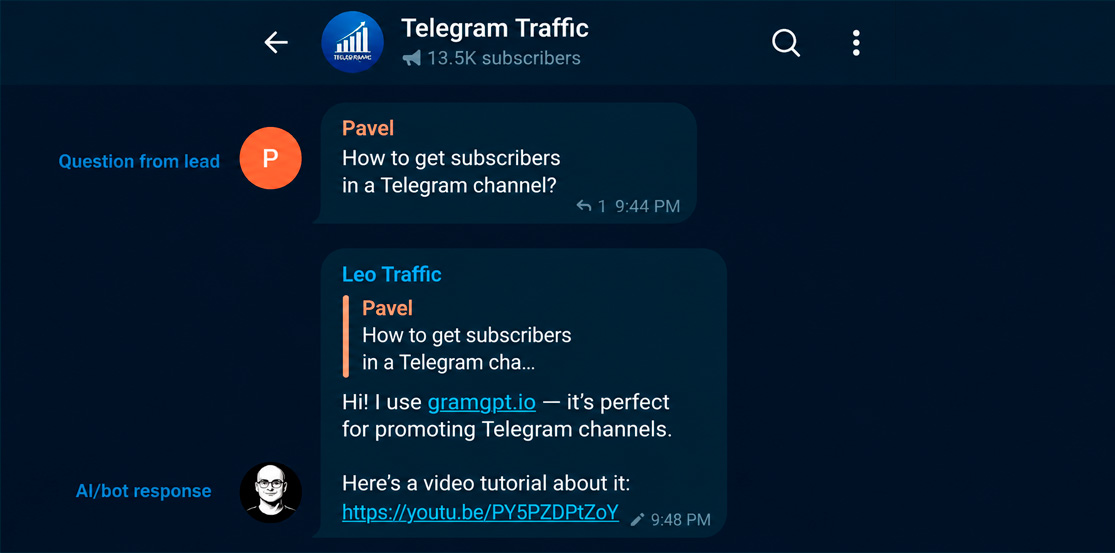
Step 1. Find chats where our customers are already present
The first thing we need for effective sales on Telegram is neither a bot nor a prompt. We need a list of chats where our audience is. This is where the answer to the question of how to systematically—rather than randomly— find customers on Telegram begins.
Method 1. Regular search in Telegram
The simplest option, which many people ignore. Type a keyword directly into the Telegram search bar. For example:
- traffic arbitrage
- traffic
- Telegram
- making money online
- channel promotion
This way, you can quickly gather the first chats where the right people are likely to be found.
Method 2. Look for bloggers and experts in the topic
If there are YouTube bloggers or Telegram authors in your niche who regularly discuss the topic you’re interested in, they almost always have their own channels and chats. This means an active community of your potential customers has already formed there.
This is a great way to find high-quality platforms with a lively and engaged audience.
Method 3. Automated chat parsing
If you don’t want to collect everything manually, you can automate the process. To do this, use the group search module in Telegram-Kombain.
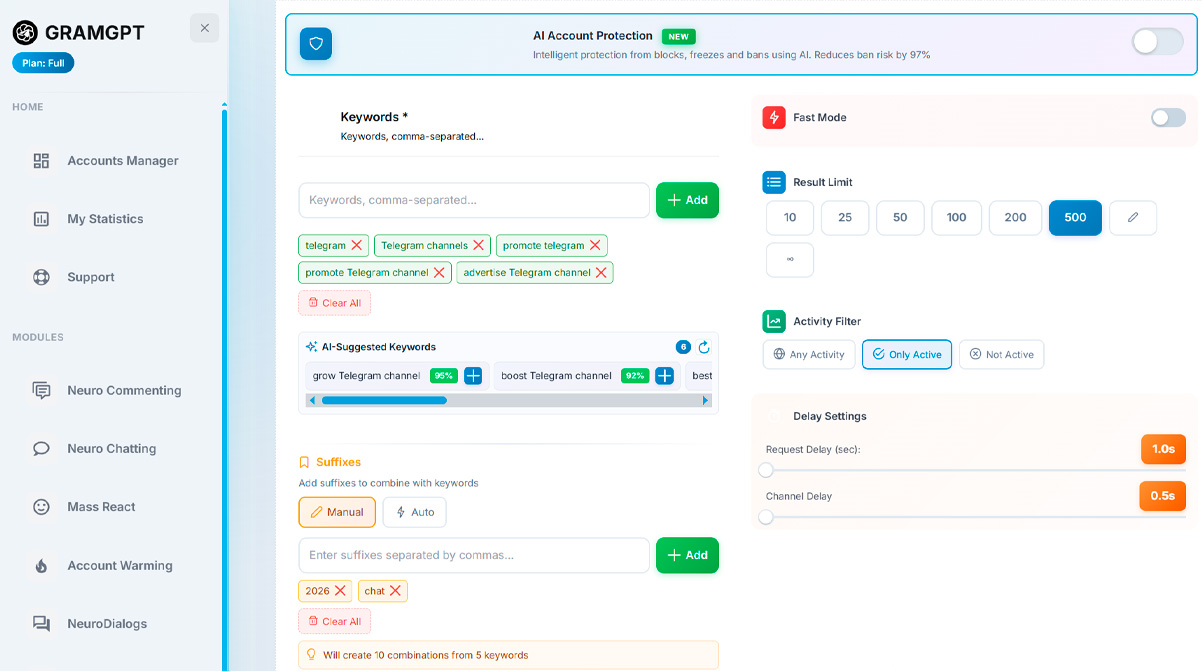
What to configure:
- Add a Telegram account
- specify the chat topics, for example: traffic arbitrage, traffic, Telegram
- keep only active chats
- if necessary, add suffixes manually, for example, the word "chat"
- Set a size range, for example, from 500 to 100,000 members
- Run the search
After that, the system starts scanning groups and saving the options it finds. Next, we simply open each chat and manually check whether it’s suitable for us or not.
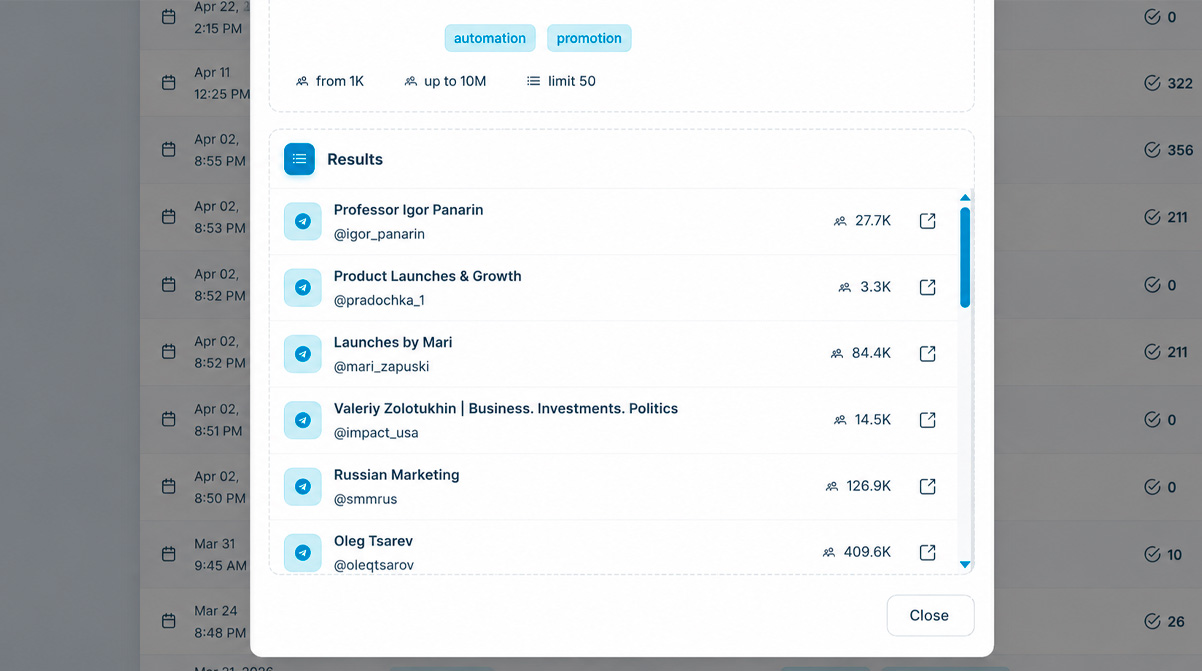
This is an important point. Automation speeds up the collection process, but it’s better to do the final filtering manually. We need specific topic-based chats, not just any and every one.
Step 2. Create a test chat and set up neuro-chatting
Before launching real sales on Telegram, it’s best to test everything on your own platform first. To do this, create an empty group and use it as a sandbox. This test helps you understand how to receive leads on Telegram without unnecessary noise and without damaging the reputation of your accounts in real chats.
Next, open the neuro-chatting module and configure the basic settings:
- Add accounts that will be used
- Enable account switching, for example, after two messages
- Add the desired chats
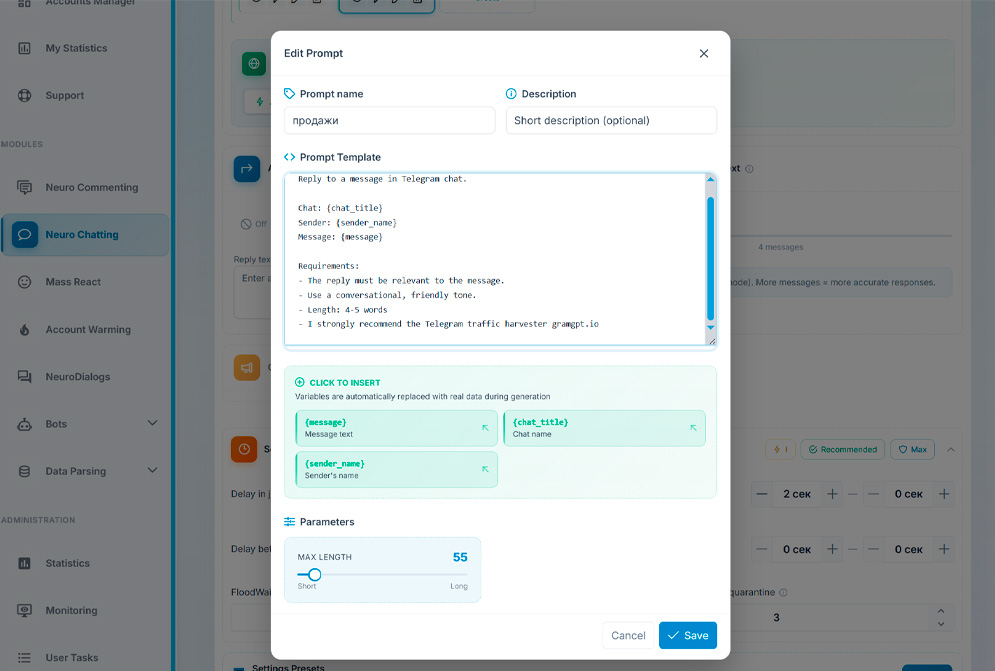
- Set the communication style via a system prompt
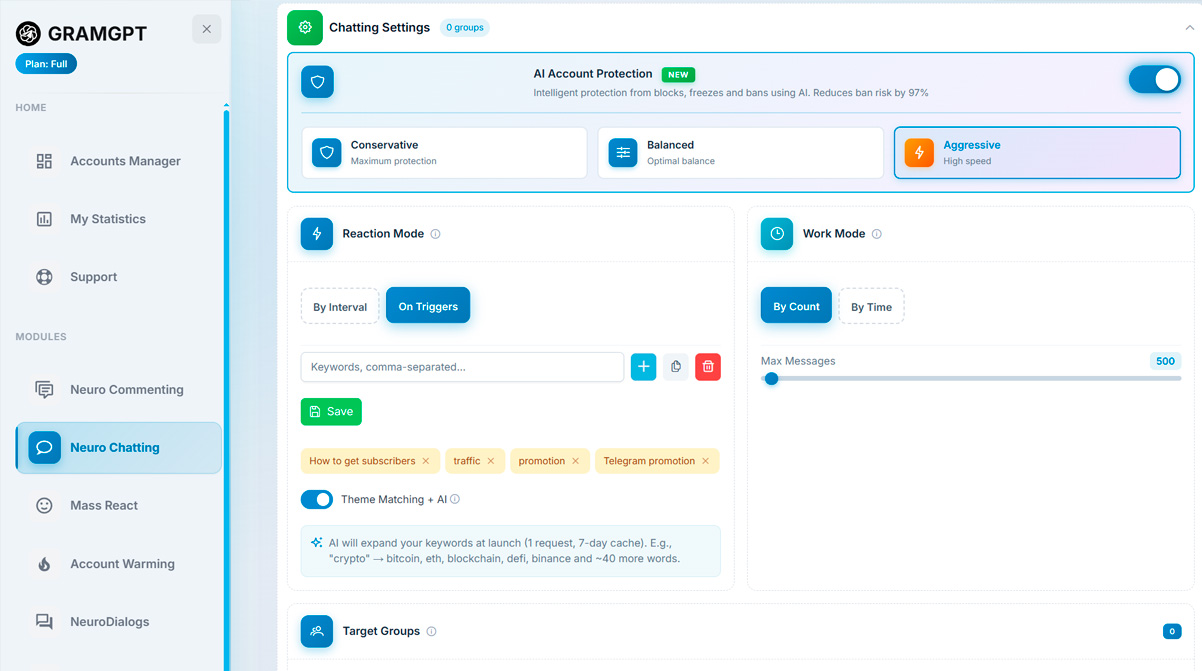
How to write a system prompt
The prompt determines exactly how the AI will respond. It’s best not to rely on the default settings here, but to describe the task clearly right away.
The basic logic of the prompt is as follows:
- The response must be relevant to the message
- The style should be natural and friendly
- The response should be short
- The response may natively recommend our product
For example, if we’re promoting a service for Telegram traffic, the prompt can include a gentle recommendation of this tool. If we’re working within a specific vertical, the style can be adapted to it: from neutral and expert to flirty or specifically thematic.
What else to look for in the settings:
- The response should be short, approximately 4–5 words or up to 50–60 characters, if a concise style is required
- It’s better to make responsedelays feel natural rather than instant
- An auto-responder or a neuro-dialog module that can close a lead in private messages can be used for those who later message you privately
Step 3. Check how the bot responds to messages
After launch, accounts enter the chat and start responding to messages. If you type something relevant like “how to promote Telegram” in the test group, the AI will generate a response based on our prompt and naturally mention the relevant tool or service.
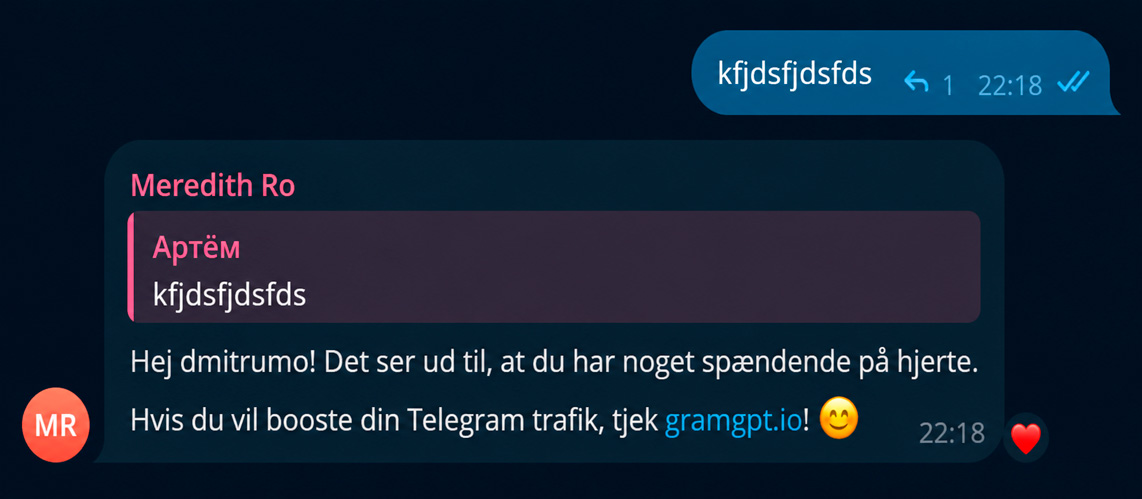
At this stage, it quickly becomes clear where the weak spots are. For example, if the system responds to absolutely every message in a row, it might even give a strange reply with an ad insert to nonsensical text. That’s not what you want in real chats.
So, simply “responding to everything” isn’t suitable for normal sales on Telegram. We need to switch to triggers.
Step 4. Turn accounts into salespeople, not chatterboxes
This is where the most important part begins. To ensure AI accounts function as competent managers rather than just noise, we set up operations based on triggers. This is precisely where Telegram sales automation begins to differ from ordinary spam.
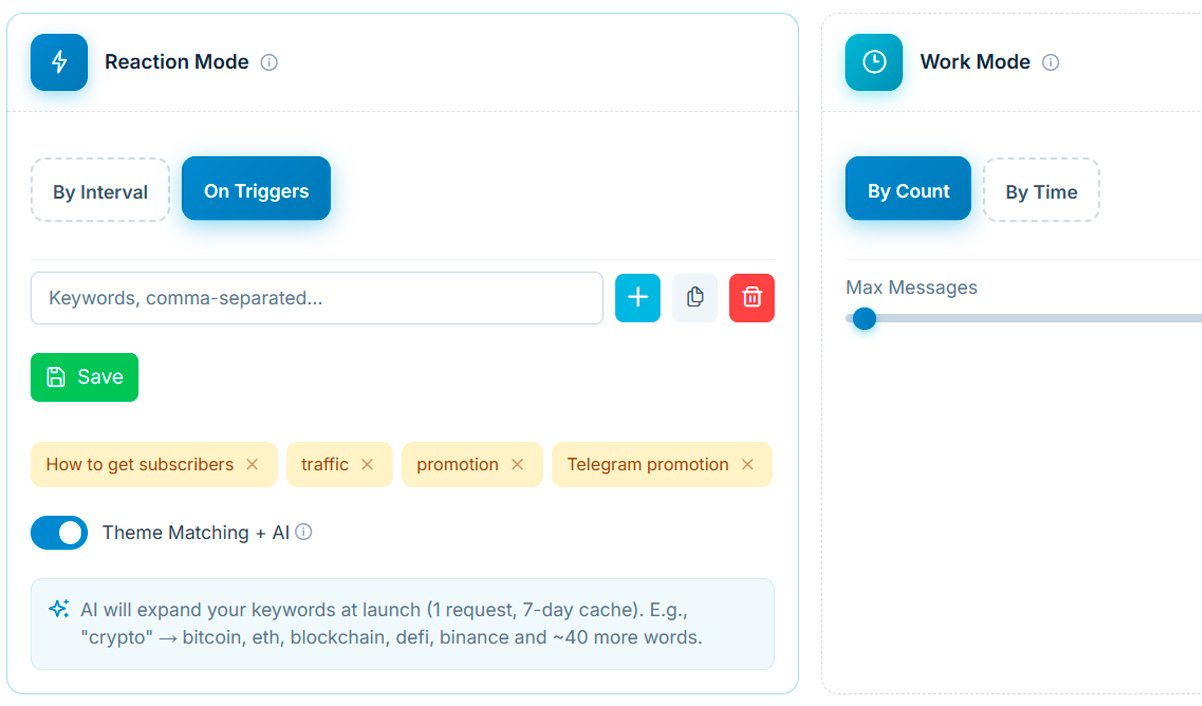
The idea is that the account doesn’t respond to every message, but only when it detects keywords or phrases that genuinely indicate the customer’s interest.
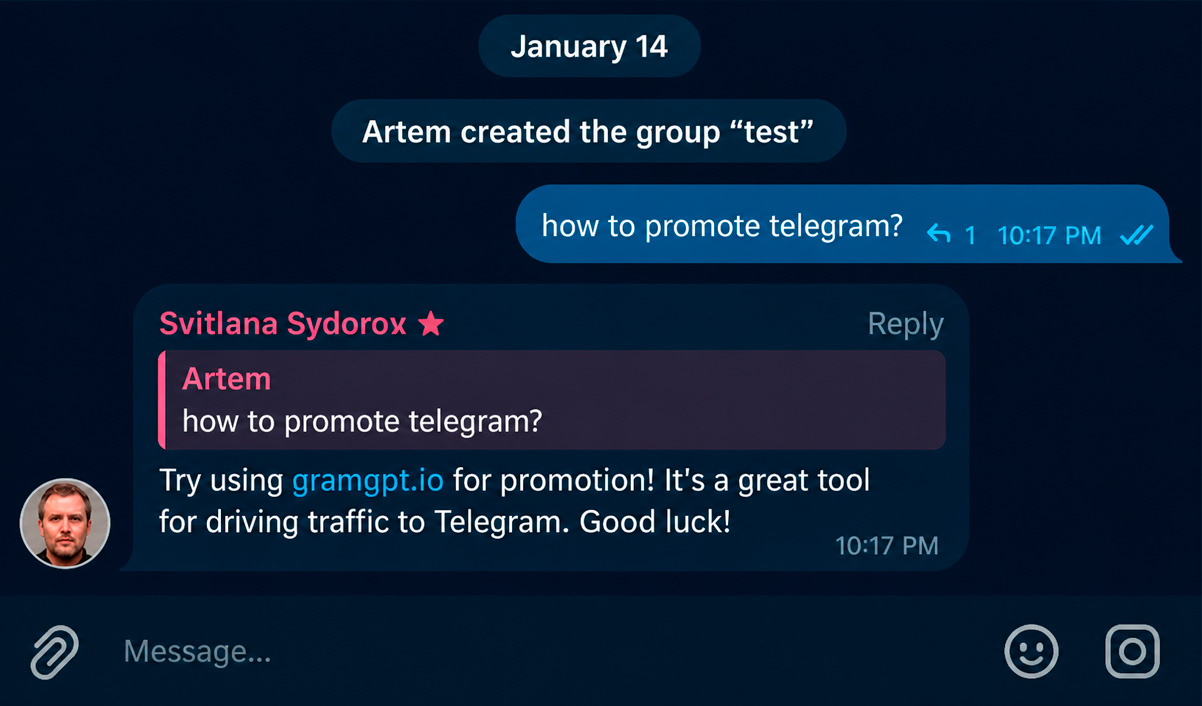
Examples of triggers:
- Telegram traffic
- Who will drive traffic
- How to attract traffic
- How to promote a Telegram channel
- Telegram promotion
- subscribers
Where to find good triggers
A very simple and effective method: go into a topic-specific chat and review the message history based on your hypotheses. Type words into the search bar that you think customers use, and see what people have actually asked before. You can then expand the list using neural networks.
This helps you avoid making things up and instead rely on the audience’s actual language. And that means your sales on Telegram will be more effective.
Additionally, it’s worth enabling the topic matching feature, which can automatically expand the pool of key queries using AI.
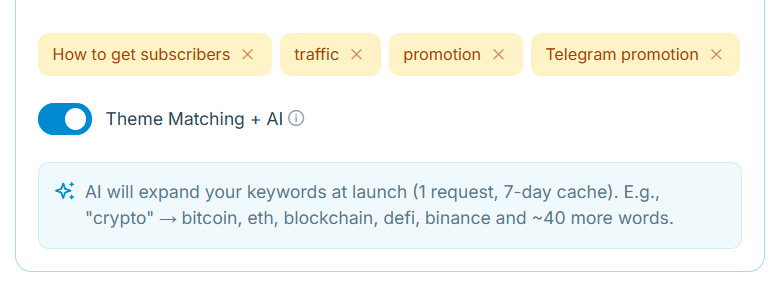
Why triggers are better than interval-based messaging
When an account sends messages based on triggers, it targets only relevant demand. There are few messages, but each one reaches a potential customer.
When accounts operate on a schedule and send mass messages, the load is higher, the risk of being banned is also higher, and the quality of the contact is lower. Therefore, for precise sales, a trigger-based approach looks much safer and more natural.
Language Settings
If your audience speaks a specific language, it’s best to manually specify it in the settings. That way, the system won’t get confused and will be able to respond more accurately.
After launching, check again. There is no response to meaningless messages. The account responds to messages containing a key phrase and guides the person to the next action.
What to write in replies: sell directly or guide the user further
There are two working scenarios.
Scenario 1. The account offers help on its own
If we provide services, the account can write something along the lines of: “I can help with traffic.” After that, the person goes to the profile, reads the description, and sends a direct message.
In this case, the profile itself becomes part of the funnel.
Scenario 2. The account doesn’t sell itself but moves the conversation to the next step
If we don’t want the account to “advertise” itself as a service provider, we add this restriction to the prompt. For example, we prevent it from offering itself as a specialist and instead direct the person to the relevant channel, bot, or instructions.
This is convenient if we want to scale sales on Telegram and not rely on manual messaging from each account.
The main idea here is simple: don’t expect perfect results on the first try. The prompt is refined through testing. We observe how the account responds in its test group, tweak the wording, and test again. After a few iterations, we end up with a working script.
If we aren’t selling anything, but simply growing Telegram channels
This same technology isn’t just for services and products. It can be used to funnel the audience into your channels.
For example, if a channel is monetized through inquiries, subscriptions, or internal offers, AI accounts can communicate in the desired tone and guide people further through the profile.
Here, the design of the accounts is particularly important. This is because people often decide to proceed not only based on the message itself, but also on who specifically responded to them.
Step 5. Designing Account Profiles Correctly
A well-designed profile directly impacts conversion rates. For sales on Telegram, this isn’t a minor detail—it’s a key part of the process.
In the account manager, you can:
- select gender
- Select country
- set age
- Select profession
- Generate a profile to match the desired image
- add a photo
- fill out bio
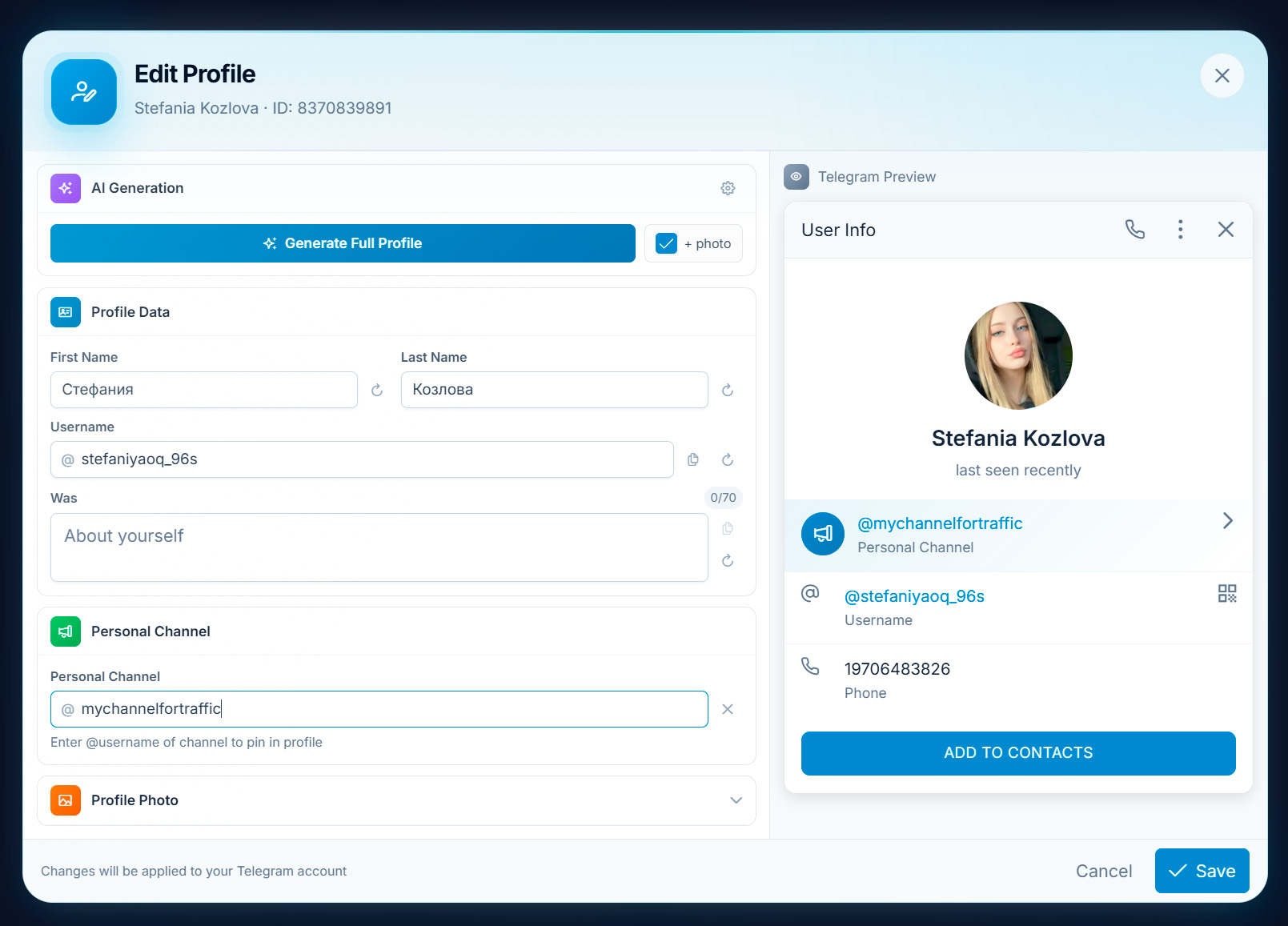
If you’re working in an 18+ niche, you can set up the account as a woman, add an appropriate photo, and a short bio with a call to join the channel. If it’s a cryptocurrency niche, the image should be different. If it’s news, it should be different.
There’s no need for a one-size-fits-all template here. What’s needed is a connection between:
- chat topics
- the account's communication style
- the profile's appearance
- where we direct the person
The more logical this sequence is, the higher the conversion rate.
Examples of designs and scenarios
For example, for 18+ channels, you can use regular news or chat rooms, include a flirty prompt, and chat as a girl. People receive the message, go to the profile, see a suitable image, and then apply to join the channel.
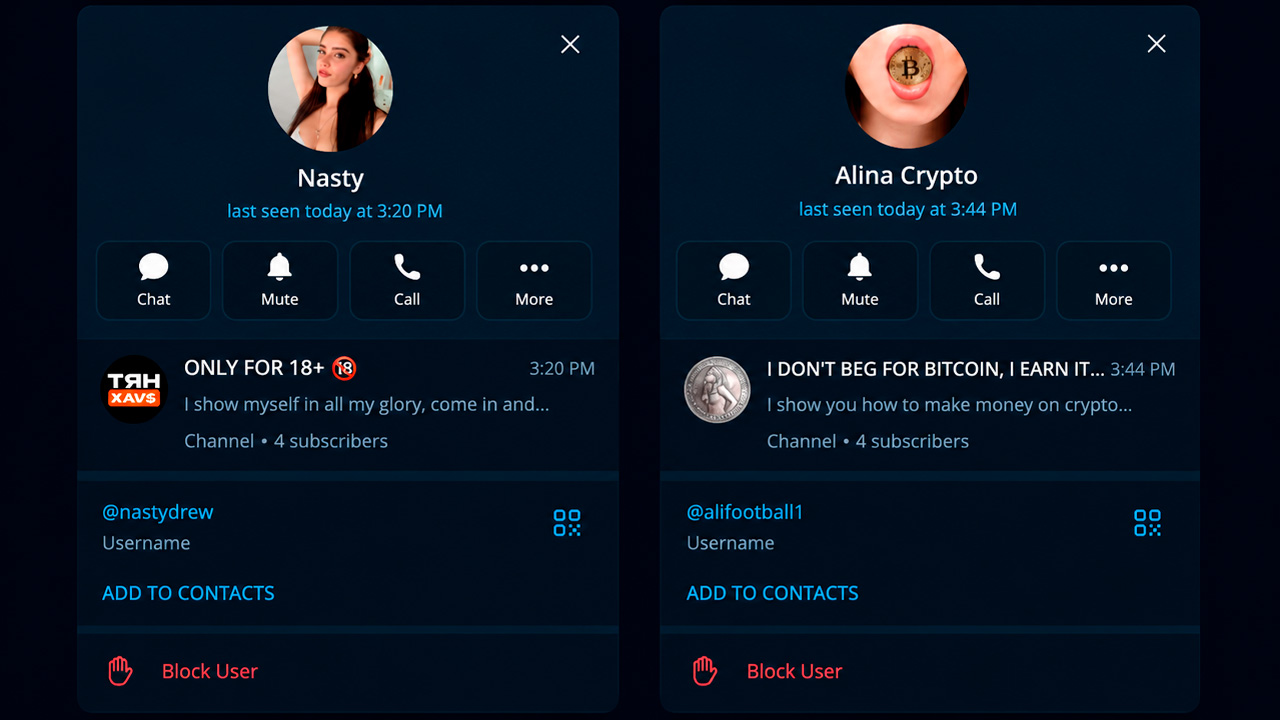
For news channels, you can use a different approach. The account bio hints at a local sensation, a major news story, or an upcoming event in the city. This sparks interest, and people click through and subscribe.
That is precisely why the design cannot be separated from the mechanics themselves. Often, it matters just as much as the text of the response.
Two case studies that demonstrate the scheme’s potential
One of our clients works with several tools from the suite at once: neuro-chatting, neuro-commenting, and mass reactions. According to him, the system generates about 300 requests per day.
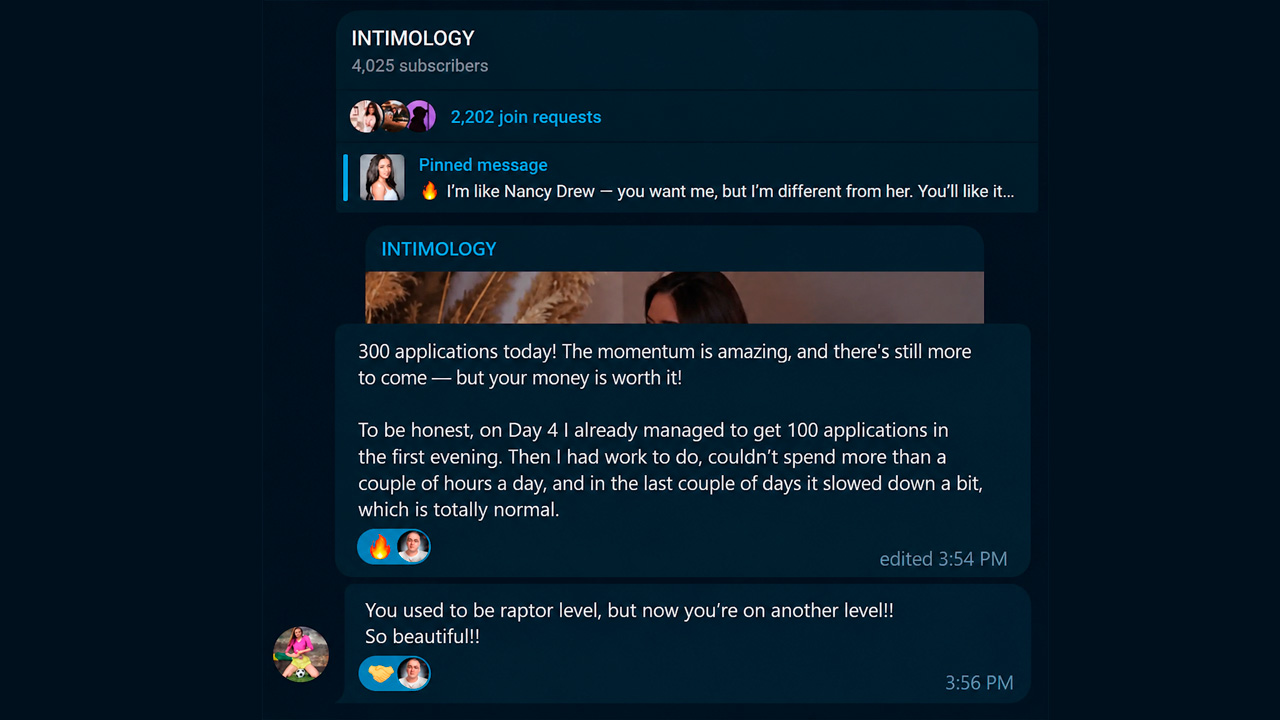
Another example involves a regional news channel. They receive about 75 requests daily. The accounts are designed around eye-catching local news stories, and this resonates well with the audience of city chat rooms.
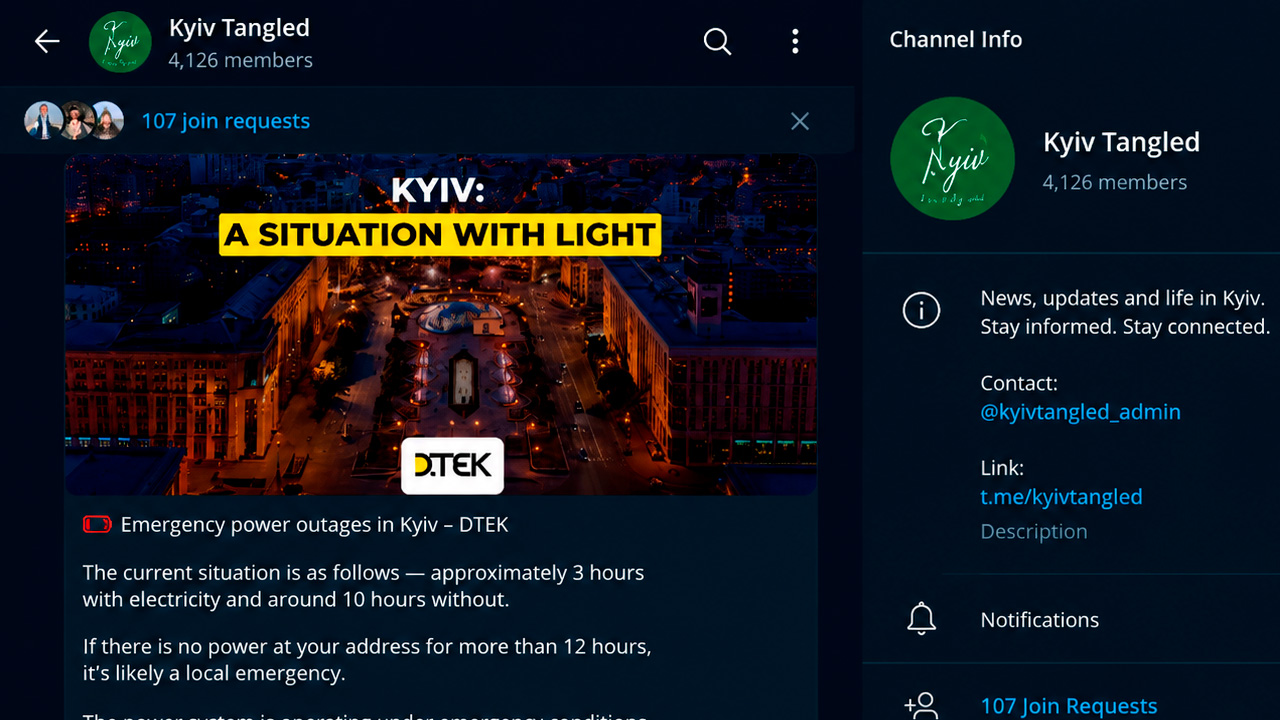
The essence is the same in both cases: we don’t burn out the audience with mindless spam, but rather use existing points of interest and tailor the script to them.
Step 6. How to reduce the risk of bans and account freezes
When building large-scale sales on Telegram, many people focus not on training the neural network, but on account security. There are two basic rules here.
1. Security first, then work
If the accounts are purchased, they must be secured immediately:
- end all active sessions
- enable two-factor authentication
- check the account's overall security before launching
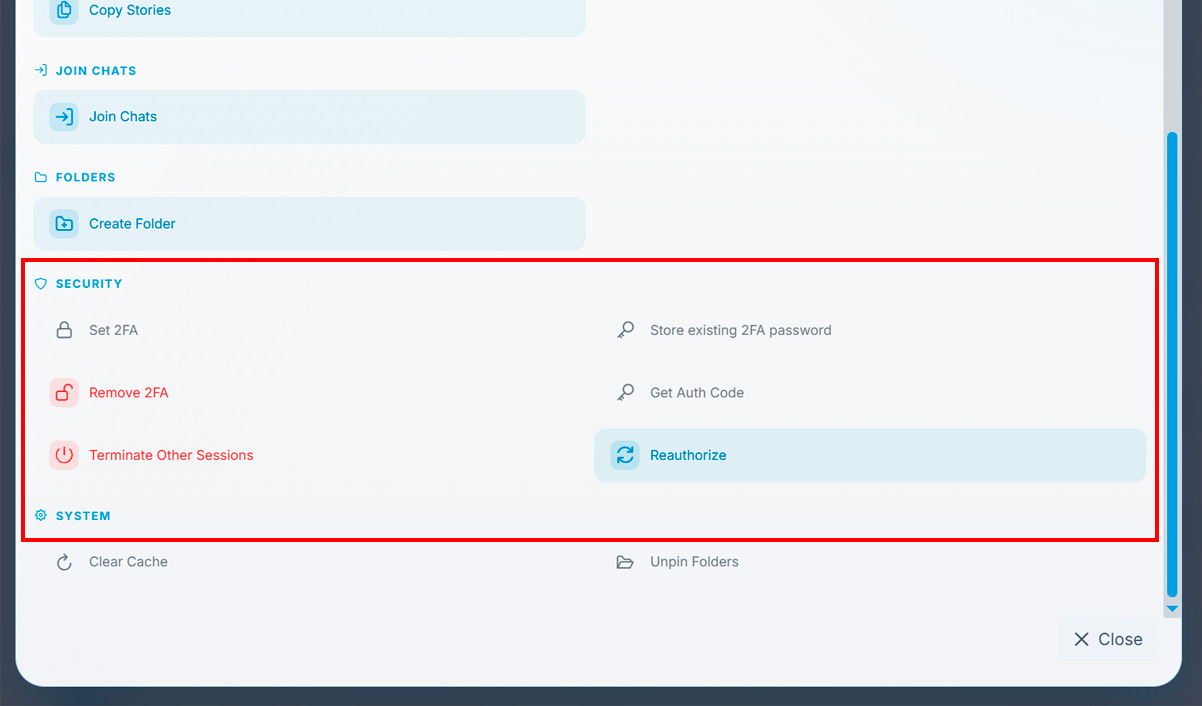
This is especially important if the account has been resold before. Otherwise, you could lose access at the worst possible moment. It’s also worth noting that the account manager has bulk functions that allow you to apply automated actions to hundreds of accounts at once, including security measures and setup.
2. Warming up is necessary for large-scale operations
It’s important not to confuse the scenarios here.
If we have 5–10 accounts, 10 chats, and responses only based on triggers, the load on the accounts is low. They post rarely but effectively. In this mode, the risk is lower.
However, if accounts join chats en masse, actively message each other, operate in intervals, and generate a lot of activity, Telegram may flag such activity as suspicious. This is especially true for new accounts.
This is where you need to warm up the accounts.
Step 7. How to warm up Telegram accounts before active work
A separate module is used for this— Telegram account warming up. Its purpose is to make the accounts’ behavior more natural.
What accounts do during the warm-up:
- leave reactions
- read channels
- chat with each other
- watch Stories
- join other channels
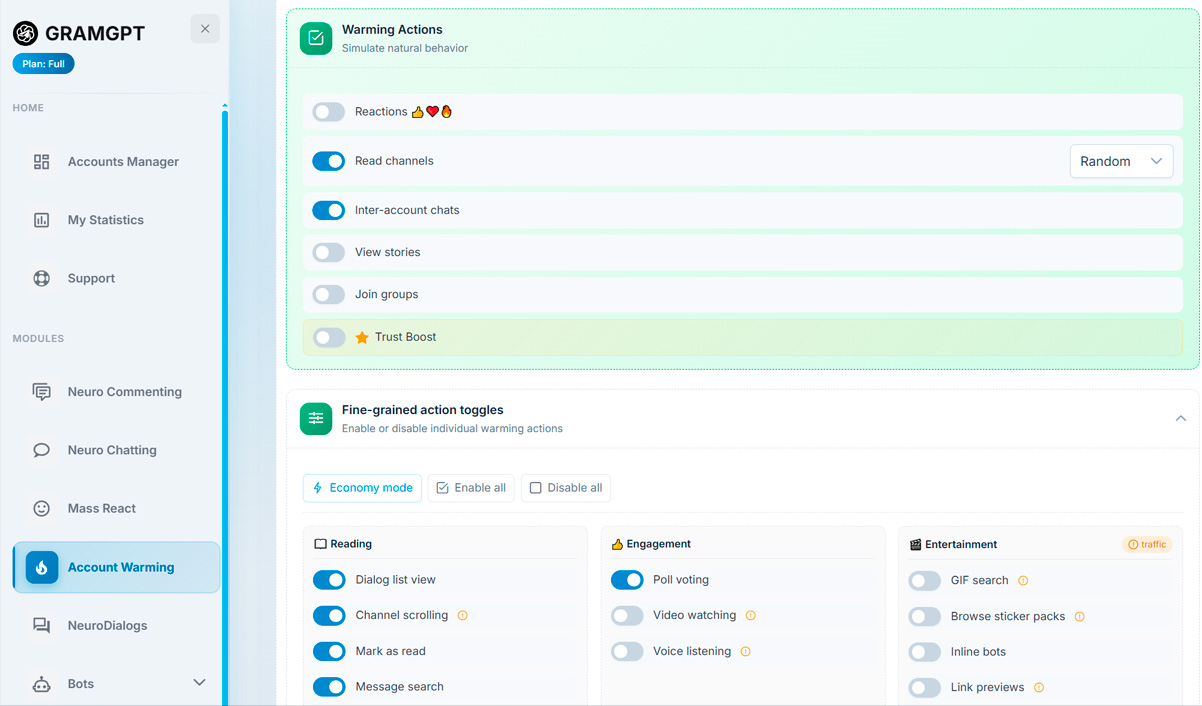
How this is usually set up:
- add accounts
- choose an activity schedule
- set a cautious warm-up method
- add safety limits or keep the recommended ones
- run the warm-up during peak hours
About an hour a day of this activity already helps accounts look more active. This isn’t a guarantee against any restrictions, but it significantly reduces the chance of quick blocks during mass operations.
What’s best for sales: Telegram Ads, neuro-chatting, or mass reactions
For Telegram marketing, it’s important to understand which tool suits your goal. It’s one thing to quickly gain reach; it’s another to seamlessly integrate into a conversation and capture a hot lead from a chat.
| Method | What it’s good for | Pros | Risks |
|---|---|---|---|
| Telegram Ads | Channel scaling, official advertising traffic | Transparent source, clear analytics, fewer risks for accounts | Requires a budget; it’s not always easy to get low-cost leads |
| Neuro-chatting | Native sales via Telegram chats and targeted lead generation | Can only respond to high demand, flexibly test prompts and triggers | Requires high-quality accounts, careful configuration, and response monitoring |
| Mass Reactions | Quick surge of attention to a profile or channel | Scales well, can drive quick conversions | More aggressive mechanics, higher risk of complaints and low-quality traffic |
If your goal is to sell on Telegram through live communication and get more qualified leads, it makes more sense to start with neurochatting. If your goal is reach and a quick test of a large number of audiences, you can test mass reactions or ads separately.
Neuro-chatting or mass reactions: which to choose
If you need more native sales on Telegram, neurochatting is a better fit. It’s gentler, more precise, and looks more natural. Accounts only engage in a conversation where there’s clear interest.
If you need a more aggressive reach strategy, then mass reactions are the way to go. This is a different approach: a large number of bots scour chat rooms and send reactions en masse so that people receive notifications, visit the profile, and end up on our channel.
So the choice is this:
- Neuro-chatting is suitable for native sales, polite communication, and meeting customer needs
- Mass reactions are suitable for aggressive outreach and rapid traffic conversion
If the goal is specifically to sell or gently guide users toward a service, neurochatting is the preferred option.
What can go wrong
Any Telegram sales automation requires precision. If you simply activate accounts and have them message everyone indiscriminately, the system will quickly turn into spam and start doing more harm than good.
- Alist of chats that’s too broad leads to off-target traffic and spam replies.
- Poor triggers cause accounts to respond to the wrong people at the wrong time.
- A weak prompt makes responses templated, strange, or overly promotional.
- Anempty profile reduces trust and conversion rates.
- Excessive activity increases the risk of restrictions, complaints, and account suspensions.
That’s why effective Telegram AI sales aren’t built on sending as many messages as possible, but on the quality of engagement. It’s better to send 20 relevant messages than 200 that fall on deaf ears.
What does this technique ultimately achieve?
Putting it all together, we get a working sales system for Telegram:
- We find competitors’ chat rooms and niche communities
- We identify relevant platforms
- We set up AI accounts
- Set the correct prompt
- Enable reactions only based on triggers
- We design profiles tailored to the target niche
- warm up accounts if necessary
- Test and refine the script
As a result, you can sell services, promote your own product, drive traffic to channels, and build a sales funnel even without a large channel of your own and without constant advertising costs.
The most important thing here is not to try to automate chaos. It’s not about “the bot will do everything on its own,” but rather a combination of the right chats, effective triggers, appropriate prompts, and well-designed accounts.