
Mass reactions on Telegram have long been used not only to inflate engagement metrics but also as a way to draw attention to accounts, channels, and sales funnels. This tactic is particularly common in the niches of Telegram traffic, arbitrage, channel promotion, and adult content.
But many people have the same question: what is the reaction limit on Telegram, and how many subscribers can you actually get using this method?
The problem is that Telegram does not publish exact official limits on reactions to other people’s posts and comments. The system operates dynamically and depends heavily on the account’s behavior, its trust score, IP address, device, activity level, and speed of actions.
Because of this, two different accounts can get completely different results even with the same number of reactions.
Is there an official reaction limit on Telegram?
At this time, Telegram has not disclosed any public limits on:
- reactions
- comments
- views
- mass engagement
- activity automation
However, based on Telegram automation practices, we can already identify several approximate safe ranges.
What is considered relatively safe
- 1 reaction every 2–5 seconds — looks relatively natural, but you need to add extra pauses after 10–20 in a row
- 300–1,000 reactions per day — usually go through fine on trusted accounts
- Random delays — significantly reduce the risk of restrictions
- Reactions in different chats — look safer than spamming in one place
That said, a lot depends on the account’s age and overall activity history.
What is already considered aggressive automation
- Thousands of reactions in a row without pauses
- Reactions 24/7 without going offline
- Perfectly consistent timing
- Too many groups in a short period of time
- sudden IP change
- New, unverified accounts
It is precisely these patterns that Telegram began monitoring much more closely following the 2025–2026 updates.
What Telegram may do in response to mass reactions
If the system deems the activity suspicious, you may face the following restrictions:
- FLOOD_WAIT
- temporary disabling of reactions
- account activity restrictions
- shadow limits
- increased risk of bans
- Telegram session logout
The following combination is particularly dangerous:
- new accounts
- rotating proxies without sticky IP
- aggressive speed
- mass actions immediately after authorization
That is why Telegram automation now increasingly uses:
- sticky/mobile proxies
- random delays
- chat limits
- human-like patterns
- account warming
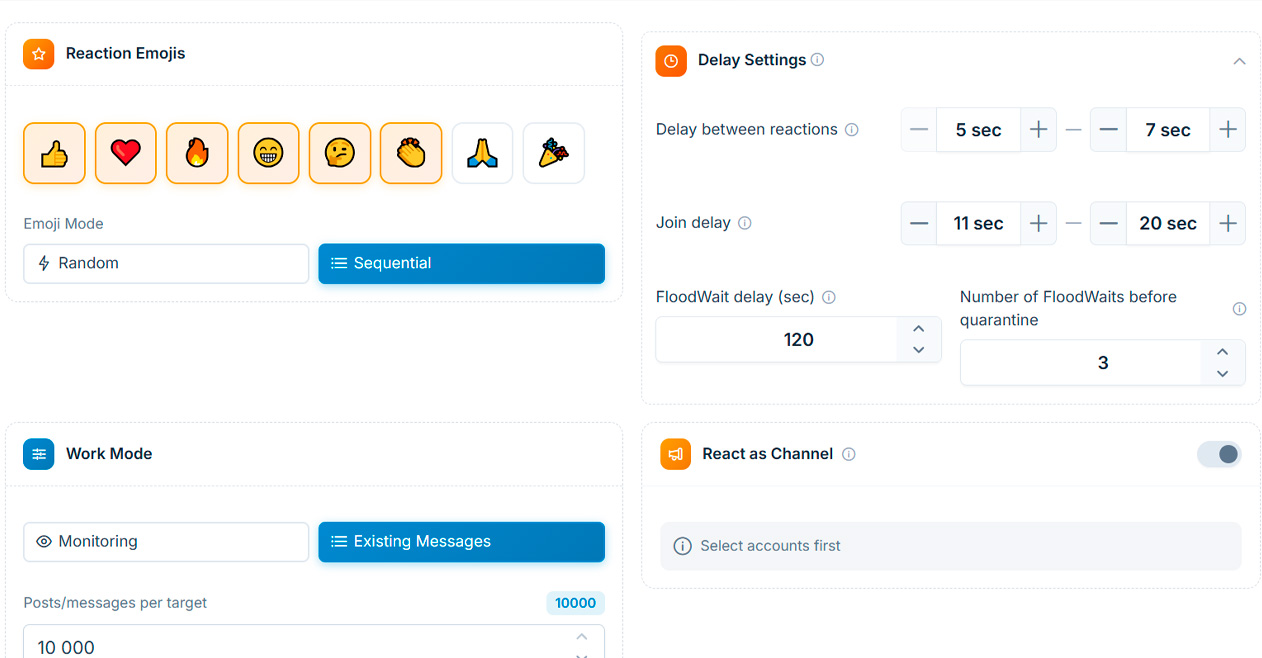
We recommend launching mass reactions through our GramGpt service, which already accounts for all possible restrictions and provides options for setting variable delays and limits.
Why Telegram has started cracking down harder on reactions
Telegram is gradually stepping up its fight against artificially inflated activity. This applies especially to:
- mass reactions
- bot comments
- view inflation
- artificial activity in chat rooms
Following the Telegram 2025–2026 updates, the platform has become significantly better at analyzing velocity—that is, the speed and patterns of an account’s actions.
The system looks not only at the number of reactions, but also at:
- timing
- repeatability of actions
- device type
- IP addresses
- account history
- natural behavior
Therefore, Telegram automation today is no longer just about “sending a lot of reactions,” but an attempt to make activity as close as possible to that of a real person. It’s worth noting that our service takes this into account using an AI module to protect Telegram accounts by mimicking human behavior.
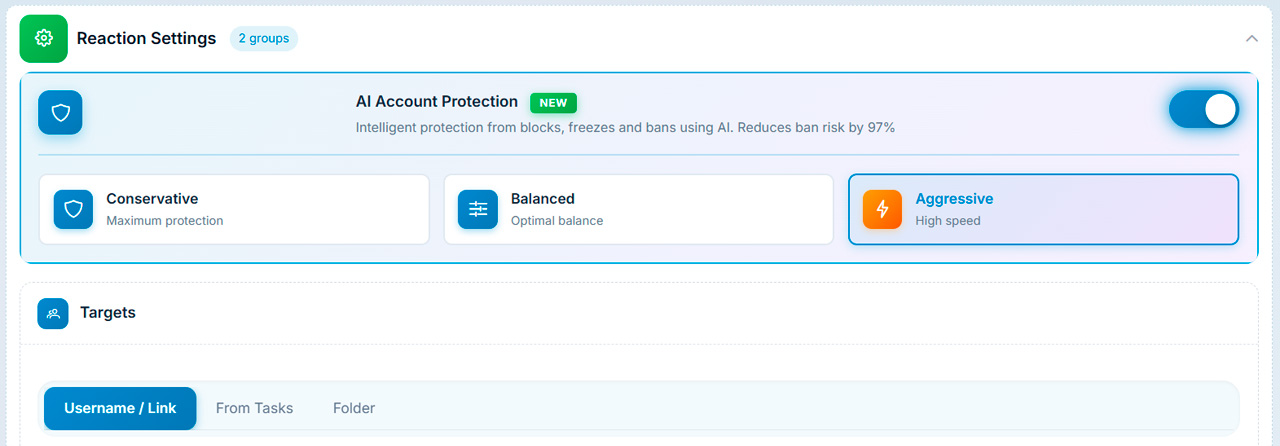
How many subscribers can mass reactions bring?
To be honest, mass reactions alone yield poor conversion rates.
It’s more of a first-touch mechanism than a full-fledged source of stable Telegram traffic.
Many expect that 1,000 reactions will immediately bring in hundreds of subscribers, but in practice, the numbers are usually much more modest.
An approximate funnel for 18+ content
If you use eye-catching profile pictures, a catchy username, and a clear bio, you can roughly expect the following funnel:
- 1,000 reactions
- 20–80 profile visits
- 3–20 followers
In a best-case scenario, you can get about 20–40 subscribers. In a worst-case scenario—0–5.
A normal conversion rate is roughly:
0.3–2% of the total number of reactions.
What affects reaction conversion
The result depends heavily not only on the number of reactions.
Effectiveness is influenced by:
- Are these live chats?
- Is there activity in the comments?
- How eye-catching is the profile picture
- Username and bio design
- Does the audience match the theme?
- Does the account look like a bot?
- Are there any Telegram restrictions?
Very often, the problem isn’t the number of reactions, but the fact that the account simply doesn’t spark interest after the user clicks through.
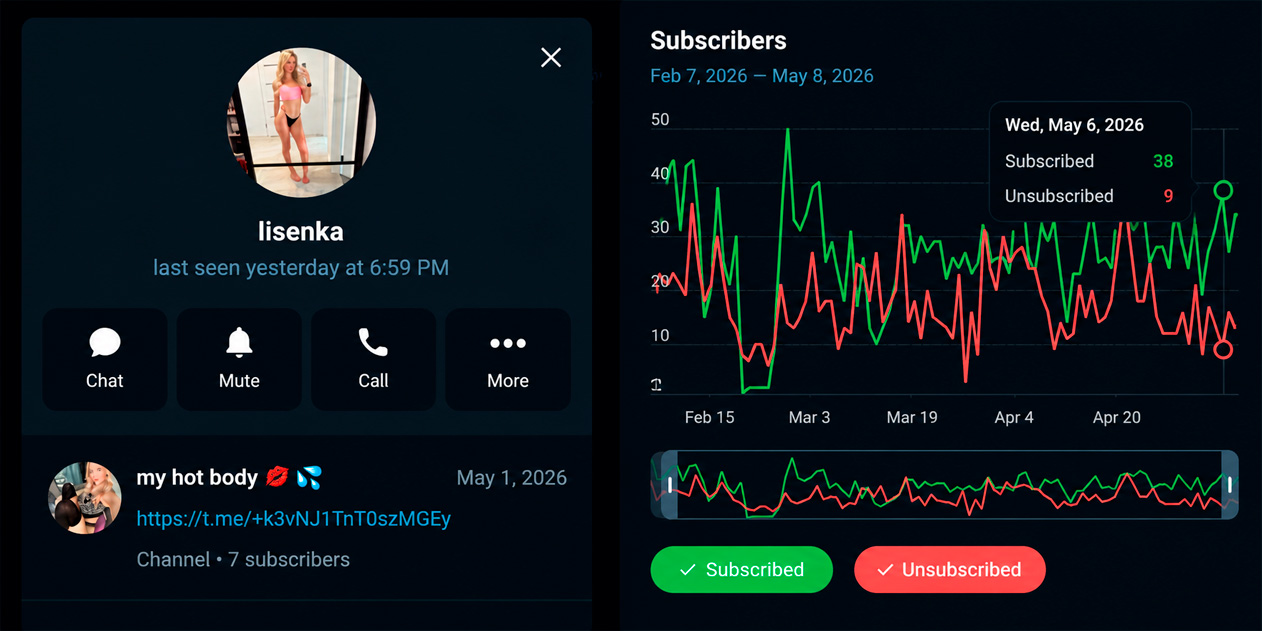
Why mass reactions are more of a hypothesis test
It’s important to understand: mass reactions rarely become a stable source of growth for a Telegram channel.
More often, it is:
- Testing new features
- checking the profile picture
- bio check
- profile conversion check
- search for active chats
In other words, 1,000 reactions are more of a way to see if a hypothesis works than a full-fledged system for building an audience.
If there is good conversion even after the first tests, then the mechanism can be scaled carefully and gradually.
What works better than mass reactions
If the goal is consistent audience growth and sales via Telegram, the following usually work better:
- neuro-chatting
- Trigger-based comments
- short videos (Reels/Shorts/TikTok)
- Telegram SEO
- content funnels
- bots for accepting requests
Because reactions generate very little engagement and rarely build strong trust.
Comments, dialogs, and content, on the other hand, can already move a person into a full-fledged Telegram funnel.
Conclusion
There is no exact limit on reactions in Telegram. The platform uses a dynamic system of restrictions that depends on account trust, action speed, IP, device, and behavior.
In practice, the following look safer:
- random delays
- moderate speed
- account warming
- sticky/mobile proxies
- chat restrictions
But even with good automation, don’t expect massive conversions from reactions alone.
Mass reactions are more of a first-touch tool and a way to test hypotheses than a full-fledged source of stable Telegram traffic.