Telegram channel parser in GramGPT is very important because if the database is weak, bought from someone else, or collected using the same methods as everyone else, any outreach campaign and any automation quickly hits a ceiling. That is why the key task is not just to find channels, but to collect a high-quality, relevant, and scalable database that you can continue working with.

Let’s break down how the Telegram parser works inside GramGPT, what this approach is useful for, where its strengths are, how to use it, and how to grow a small initial sample into a much larger channel database.
What Is a Telegram Parser and Why Do You Need It?
Telegram channel parser is a tool that allows you to:
- search for channels by keywords through Telegram search,
- filter them by specific parameters,
- expand the collected database through similar channels,
- save results in the parsing history,
- export the database in different formats for further analytics and automation.
From a practical point of view, this is useful in three scenarios:
- outreach campaigns to a relevant audience,
- collecting active users from the found channels,
- automating work with channels, including commenting and other actions.
How Does a Telegram Channel Parser Work Through Search?
The main problem with most solutions is simple: people either buy ready-made databases or collect the same sources that everyone else is already collecting. As a result, they end up with an overheated audience and weak campaign performance.
The logic here is different. First, we take the initial results from Telegram search, and then expand them through recommendations of similar channels. Because of this, the database becomes more alive and broader than with a regular search by a few keywords.
This is exactly where the practical value comes from: the Telegram parser is not limited to the search bar only, but uses it as a starting point.
Where the Work Starts: Importing Accounts
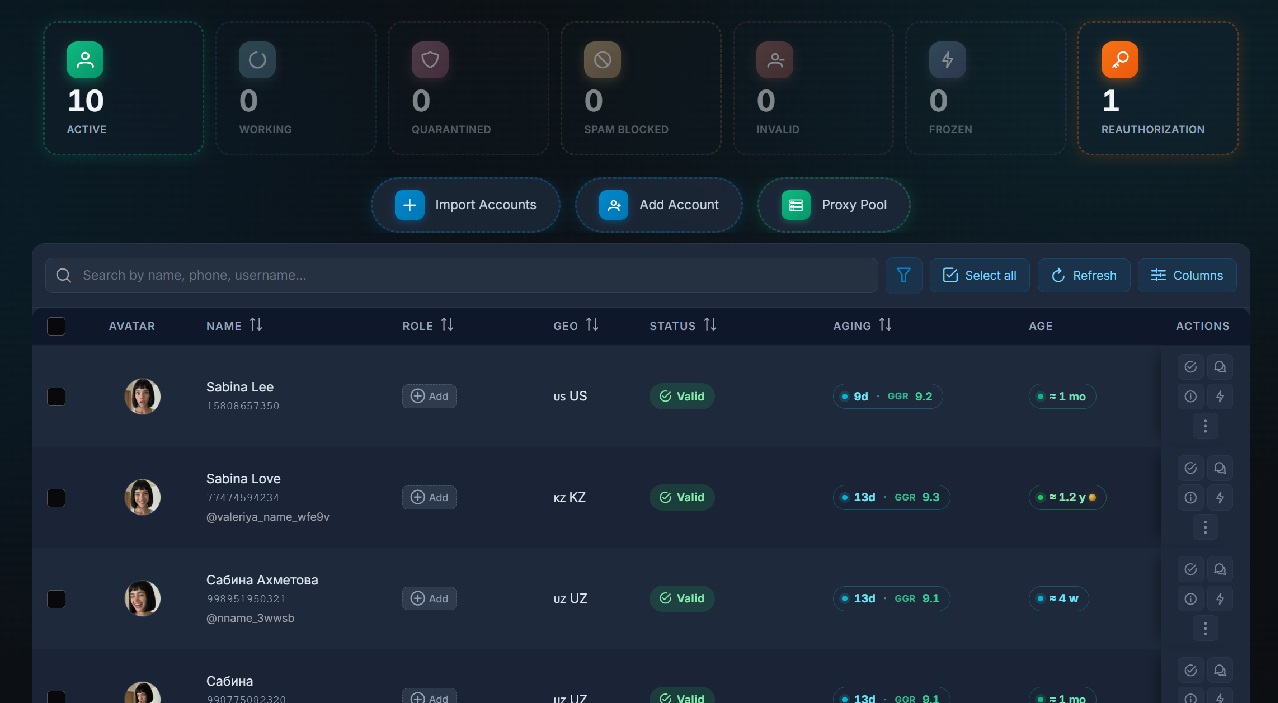
Before launching Telegram channel parsing, you need to connect the accounts that will be used for search. The interface has a separate account import section for this.
Adding accounts through Tdata or Telethon sessions is supported. This is an important point because the parsing itself runs through connected accounts, which means that without this step, the further process simply will not start.
What are the advantages of parsing through your own accounts:
- unlimited channel search without paying for each parsing task,
- you can choose which accounts will participate in the task,
- you can configure detailed settings without overpaying for filters
If you specifically need to build a channel database and not run more niche scenarios, it is enough to connect accounts and go to the channel parsing section.
How Telegram Channel Parsing Works by Search
Next, open the channel parsing section and set the basic parameters. The process is based on keywords that Telegram will use to search for suitable channels.
For example, if we need the crypto niche, we can use a set like:
- crypto,
- cryptocurrency,
- bitcoin,
- trading,
- signals,
- blockchain.
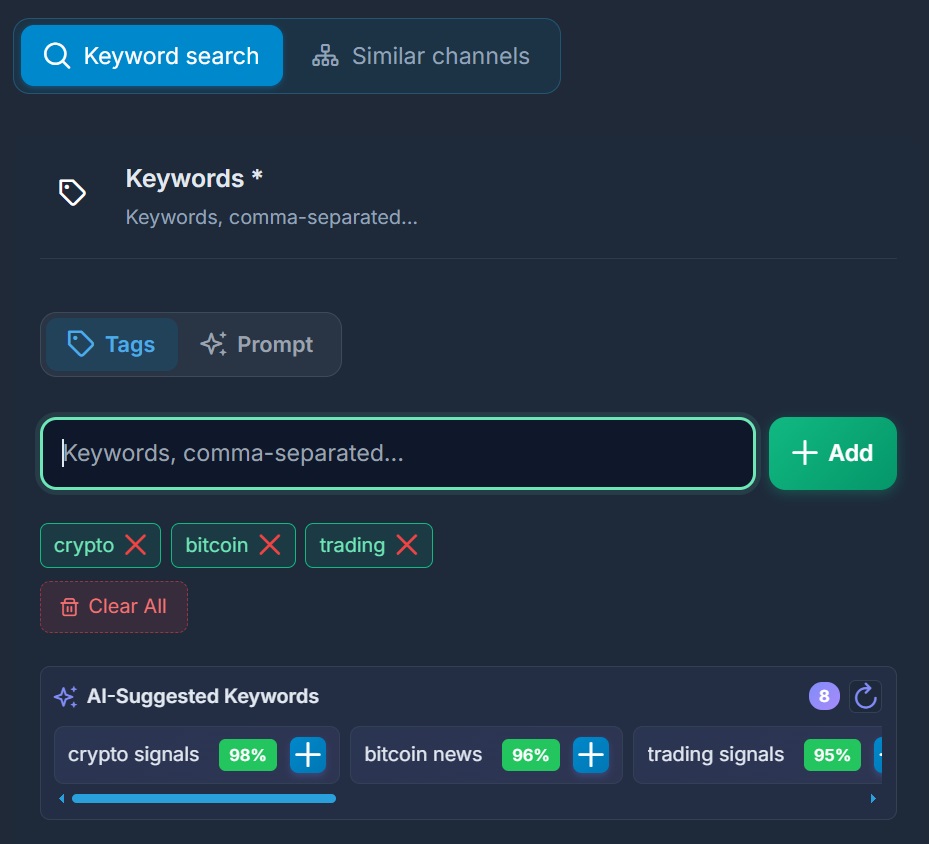
The system also suggests options through AI, but the point is not to blindly copy the entire suggestion. These suggestions are useful as a guide for expanding your keyword semantics.
If you do not know which keywords to specify for search, use the “prompt” function, which helps generate a keyword database based on the niche you need:
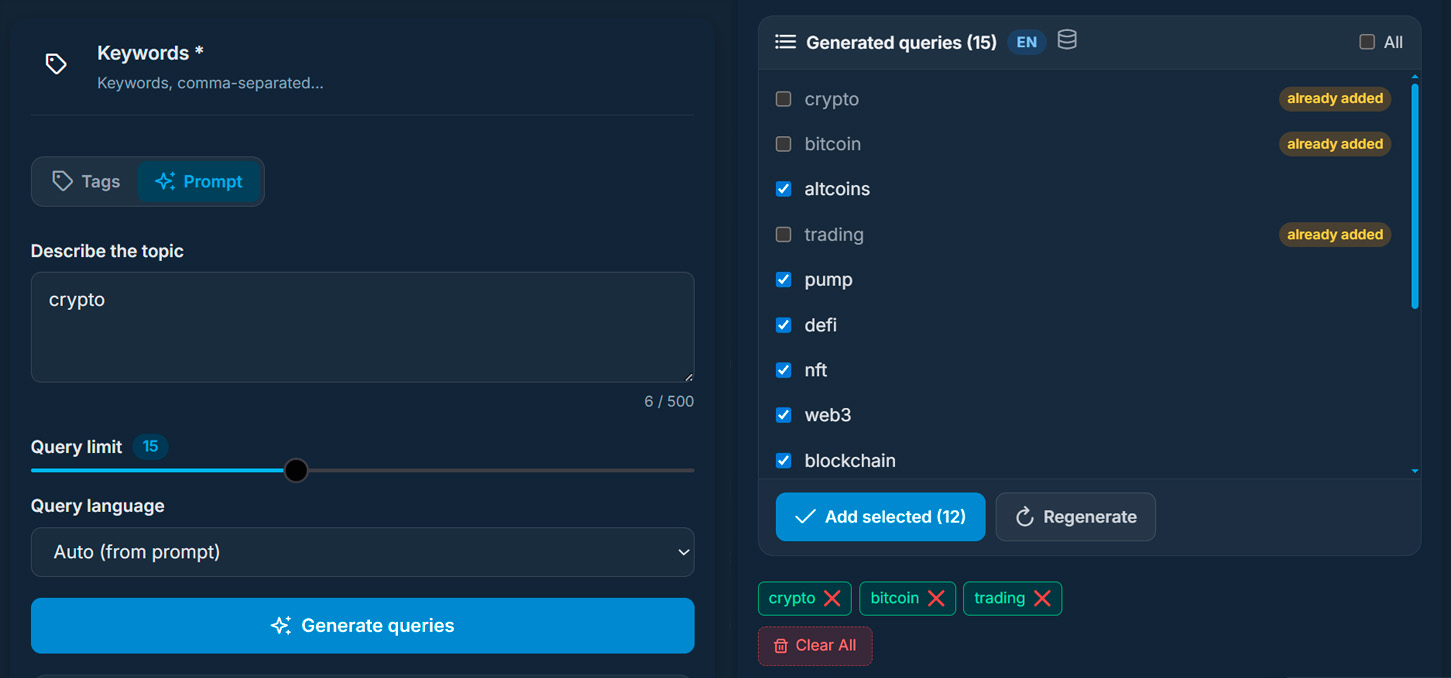
Additionally, we can specify endings and combine the main keyword with extra endings and clarifications.
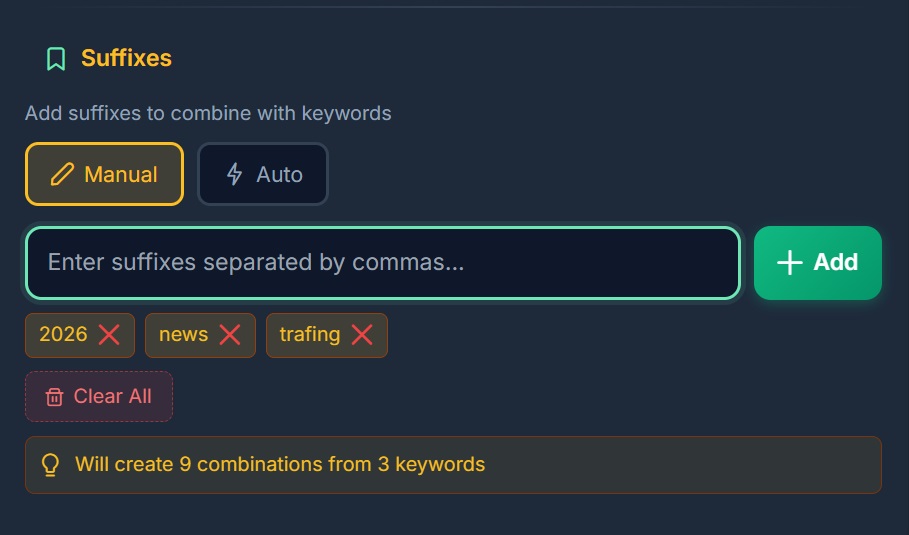
That means the search can be performed not only by one word, but also by multiple combinations. For example:
- cryptocurrency news,
- crypto 2026,
- crypto trading,
- crypto signals.
This allows you to get the most out of standard Telegram search, which is quite limited on its own.
What Filters Can Be Set When Collecting a Telegram Channel Database
To avoid collecting everything in a row, it makes sense to set basic selection criteria from the start. In the shown scenario, the following filters are used:
- Telegram channel activity
- channels with open comments, without comments, or all channels
- subscriber count range
- channel rating for outreach
- Telegram channel languages
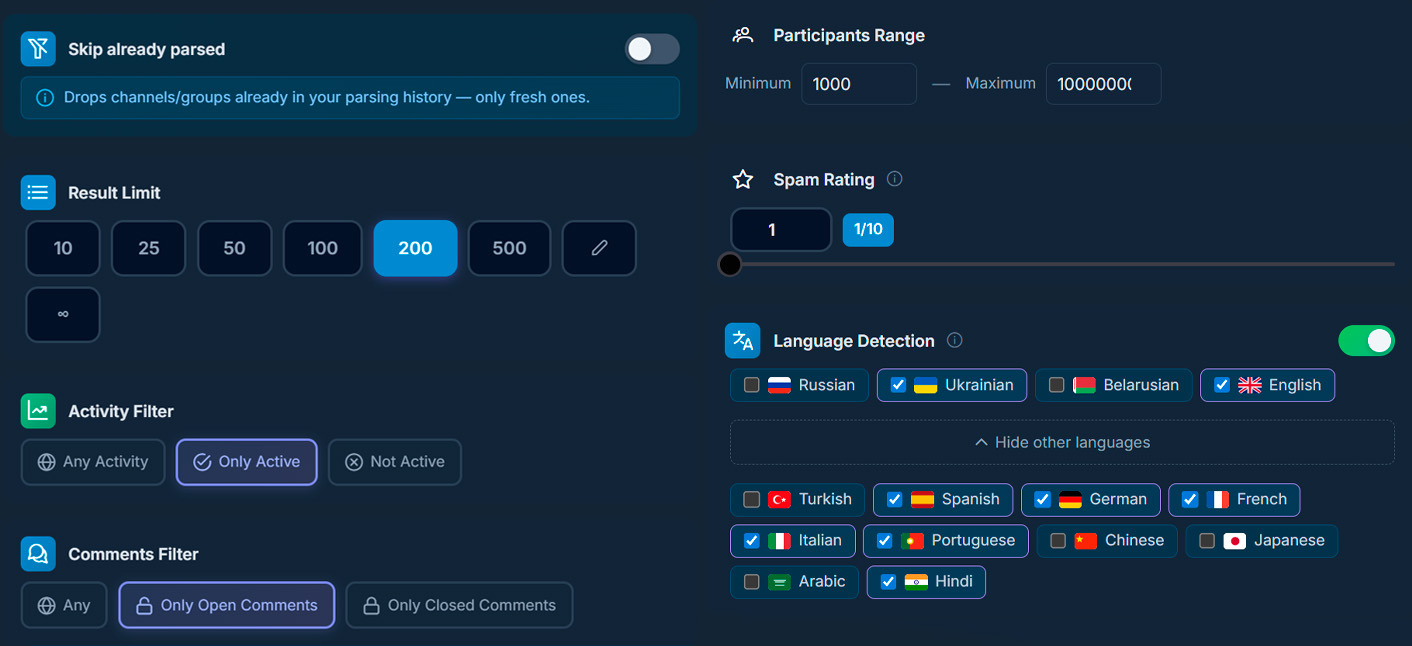
This already makes the sample much cleaner. Instead of irrelevant noise and random entities, we get a more usable database for real tasks.
How Does the Telegram Parser Find the Right Channels?
The mechanics here are simple enough, but many people underestimate them. The service automatically iterates through keywords and their combinations, runs them through Telegram search, and then checks every found object against the selected conditions.
If bots or irrelevant results appear, they are filtered out. If a channel fits by subscriber count, comments, and other restrictions, it gets added to the database.
This method can be used to collect not only crypto channels. The same approach works for any niche:
- fishing,
- hunting,
- news,
- finance,
- local niches by country and language.
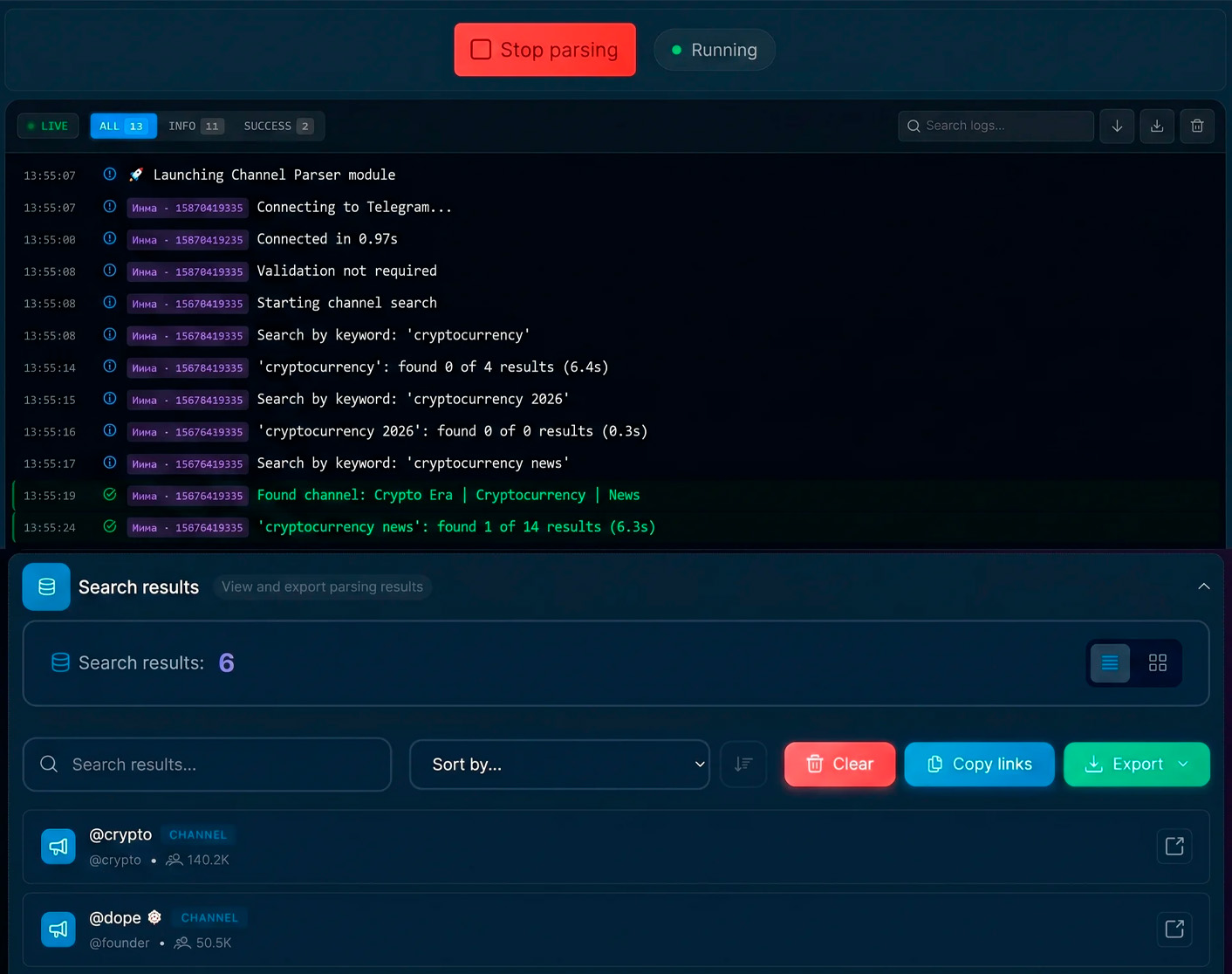
But standard Telegram search has an objective limit. It does not return an unlimited number of results. Usually, the output is restricted, and it is difficult to collect thousands or tens of thousands of channels through search alone.
This is where the most interesting part begins.
Key Feature: Parsing Similar Telegram Channels
If you use only search, you get a starting sample. But if you connect similar channels, the same database starts growing many times faster.
Telegram has a recommendation block with similar channels. On a regular account, this is roughly 10 recommendations, and with Telegram Premium, you can get up to 100 similar channels for one source channel.
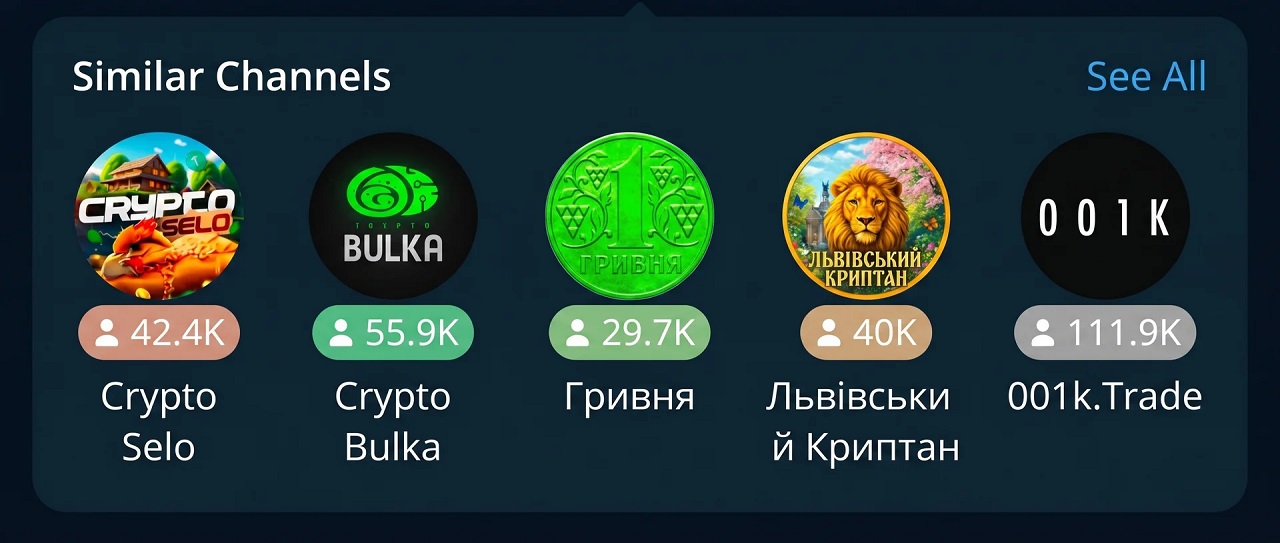
The logic is very powerful:
- First, collect starter channels by keywords.
- Take the found list and send it to search for similar channels.
- Get new channels filtered by the same conditions.
- If needed, repeat the process again using the new sample.
This is how a Telegram parser turns from a simple search tool into a channel database scaling instrument.
What to Consider When Searching for Similar Channels
There are several nuances here that are better to understand in advance.
- The topic can become slightly blurred. Especially if you set a high depth. First, we find a similar channel, then channels similar to it, and on the second step the relevance may already be less precise.
- There will be duplicates. This is normal. If the same channel appears in recommendations several times, the system simply filters out repetitions.
- Depth should be chosen consciously. If you need a more accurate database, it is better to keep depth at 1. If you need more volume and are ready to clean the sample later, you can go deeper.
In the demonstration, the first depth level is selected because even this is enough to get noticeable expansion without moving too far away from the topic.
How It Looks in Practice
After collecting the initial database, you need to export it as links. You can do this by clicking “Copy links.”
Then switch from keyword parsing to similar channel parsing and specify the list of collected links:
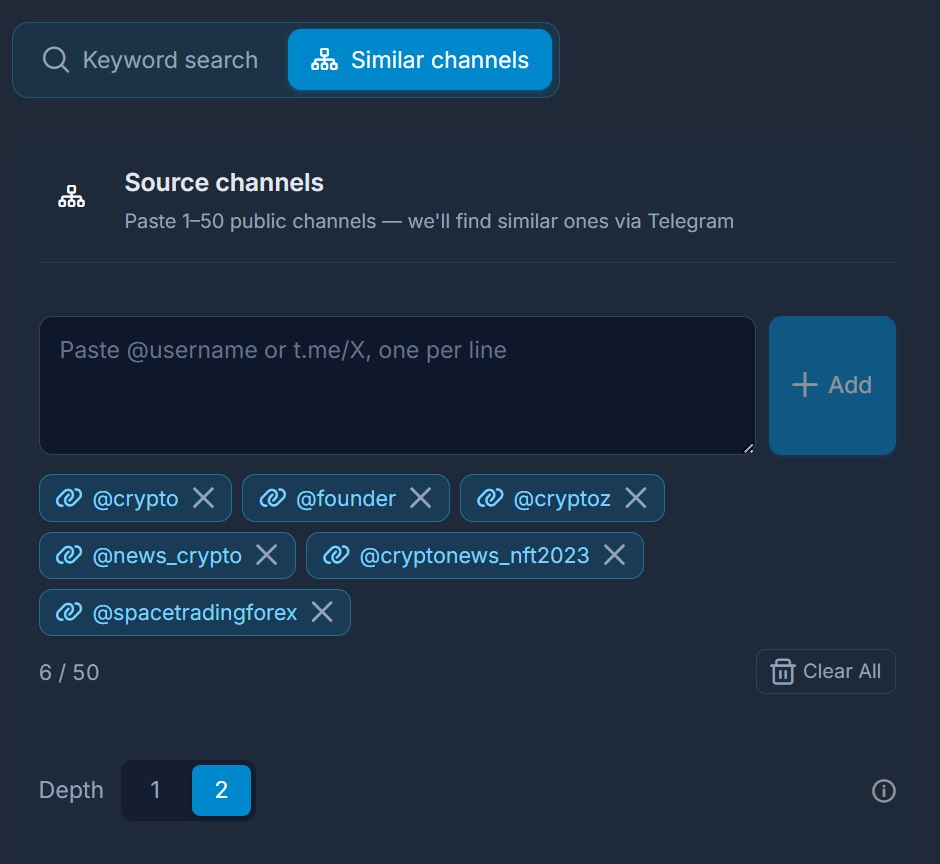
After launching the task, the system clears the current list and puts the processing into the queue. Then, recommendations are pulled for each source channel. Duplicates and everything that does not pass the filter are removed from these recommendations.
For example, if one channel brings 10 recommendations, some of them may overlap with what has already been found. That is why the final increase will not be exactly 10, but less. However, when several channels are processed, the database still grows very quickly.
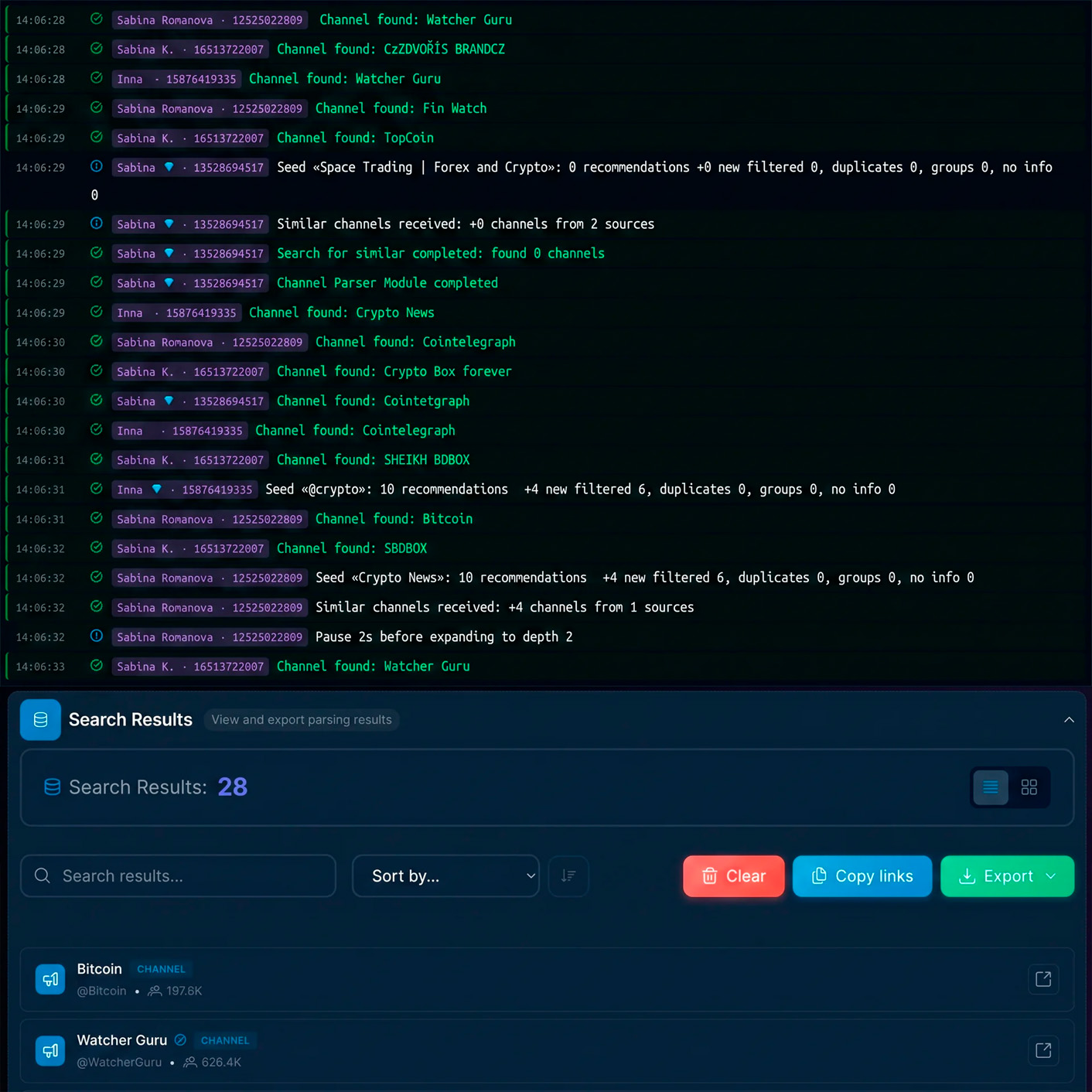
Then we can take the new channels and run them through similar channels again. This is the chain expansion of the database.
How Well the Database Scales
The strong side of the tool is that it allows you to expand iteratively. You are not limited to one small starting sample.
The workflow looks like this:
- collect the first channels through search,
- get similar channels based on them,
- copy the new list,
- launch the next run using the expanded database,
- get even more channels.
You can submit dozens of channels at once as input for similar channel search. The interface mentions the ability to set a starting database of up to 50 items. This is already enough to collect large samples step by step.
As a result, we get not just a set of links, but a database that matches the predefined conditions: subscribers, activity, comments, language, and other parameters.
Saving Results and Export
Another practical point: you do not need to manually save results every time during the process. The parsing history stores all launches, and you can return to them later.
This is convenient for two reasons:
- the intermediate result is not lost,
- you can compare different launches and different approaches to database collection.
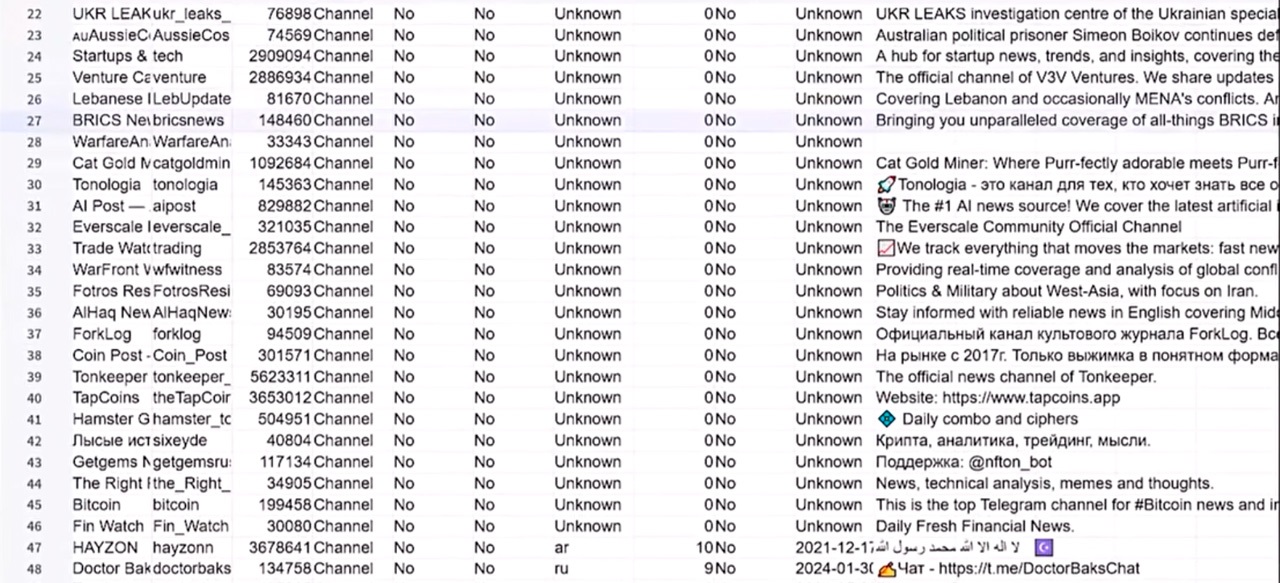
Several export options are available from the history:
- export to Excel,
- copying text links,
- extended export with additional data.
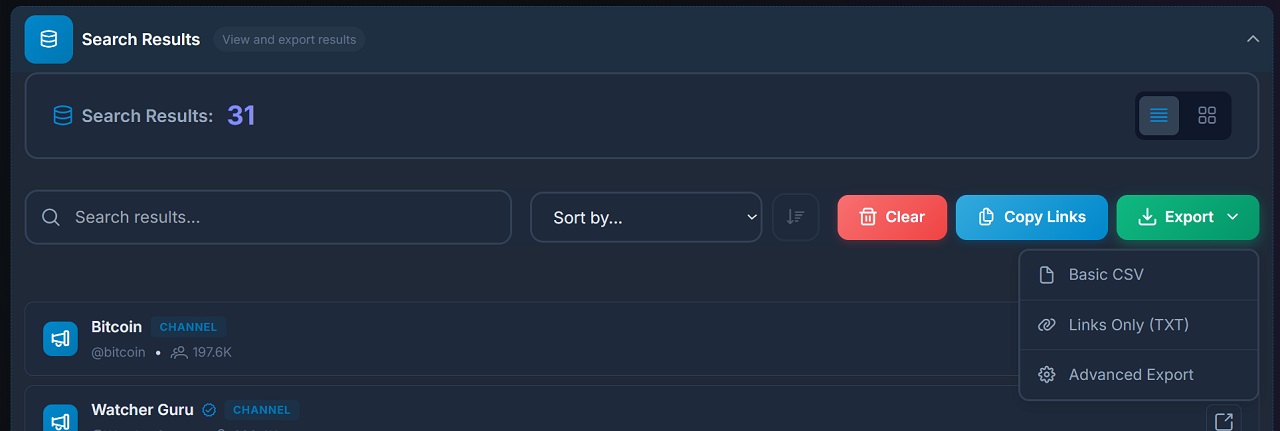
With extended export, you can get not only basic channel information, but also more practical data for analytics, outreach, and technical processing.
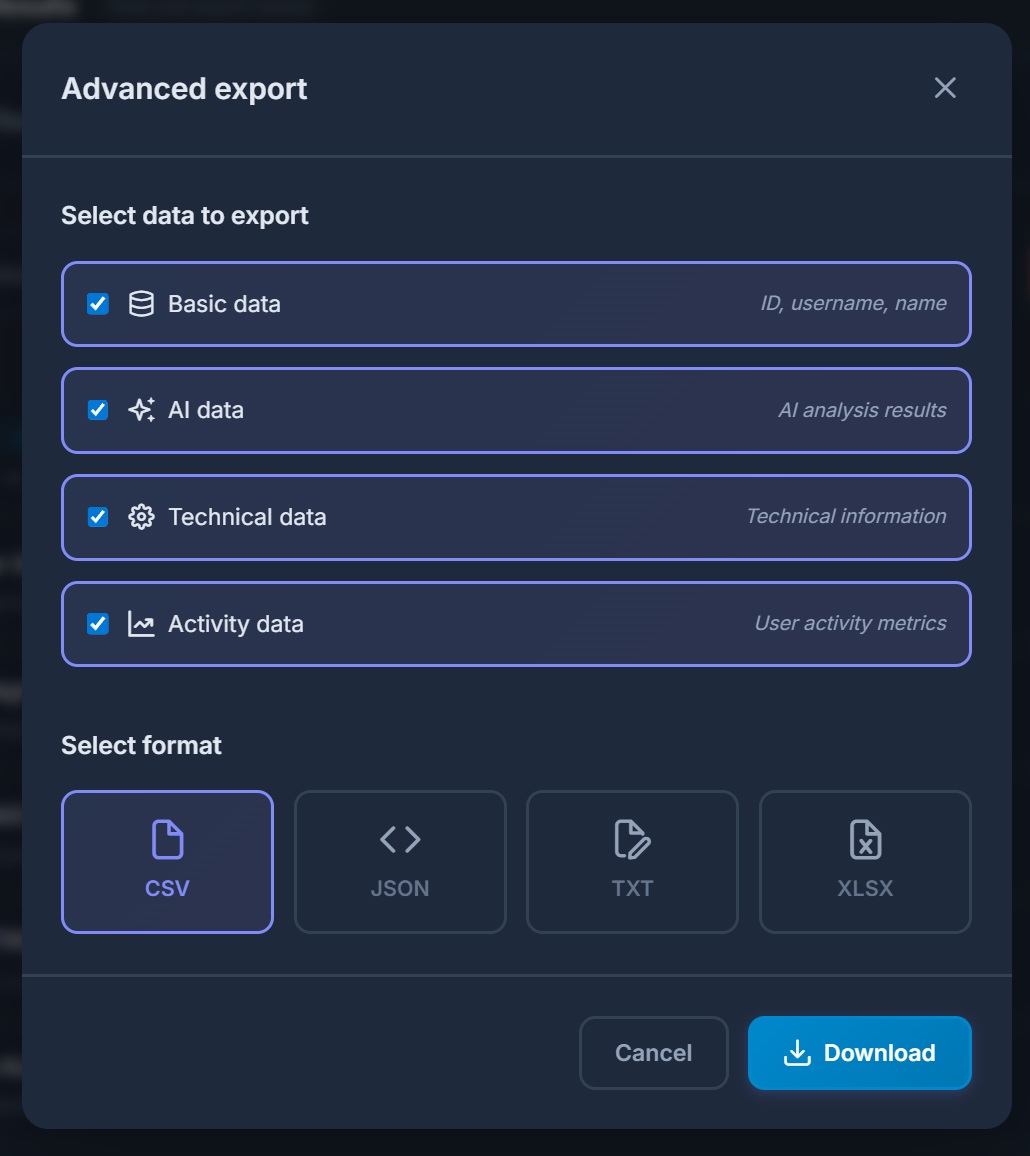
If the task is not just to collect a list, but then rank it by quality, this is especially useful.
What You Can Do with the Export
After export, the database becomes a working asset. You can:
- analyze it manually,
- run it through ChatGPT or another AI tool,
- select the best channels for a specific offer,
- use it as a source list for the next automation stages.
It is important that the found database is permanently saved in the parsing history:
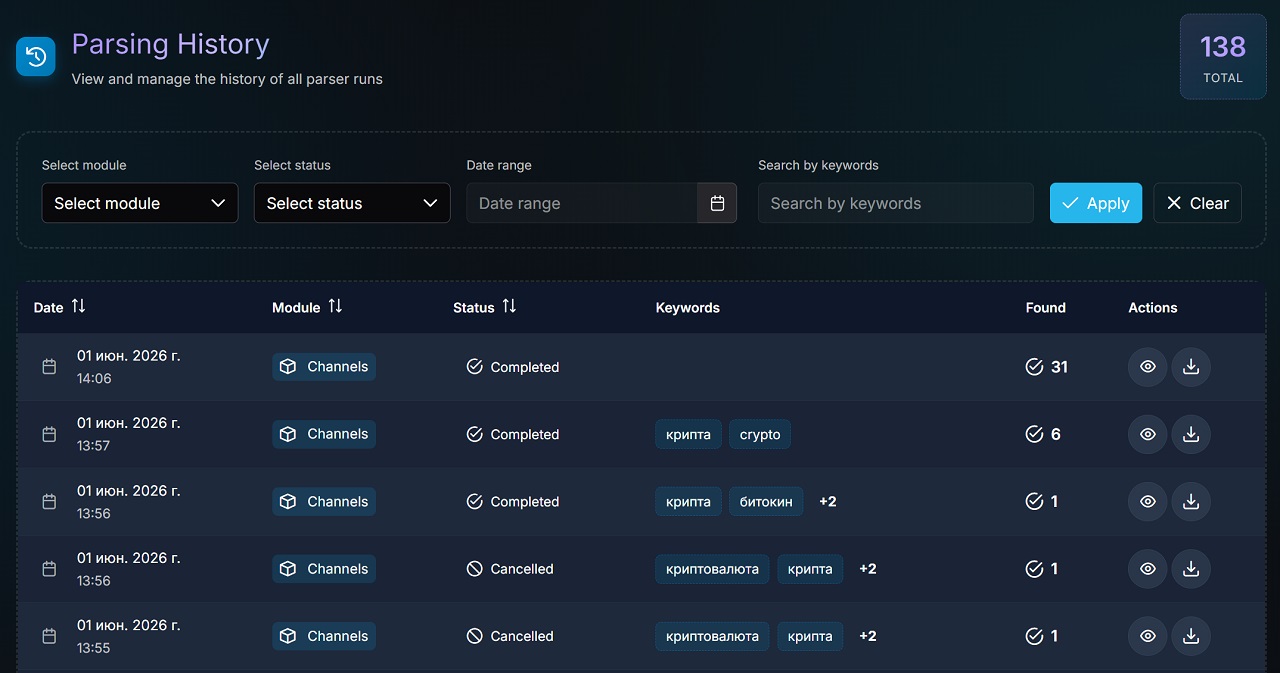
That means the Telegram parser here acts as the first link in the chain. It does not end the work at search, but prepares data for further actions.
How to Use the Collected Database and Find an Audience in Telegram
The collected database has at least two practical directions.
1. Extract Active Users from Channels
If we have a list of relevant channels, we can use them as an audience source. For this, the channel database is taken and user parsing by comments is launched.
As a result, we get a list of active people who actually interact with content inside the target niche. If it is crypto, then these are users who are already interested in crypto. For outreach campaigns, this is much stronger than working blindly.
2. Use Channels for Automation and Outreach
The second use case is related to automatic activity in channels. If you collect channels specifically for AI commenting or other automation scenarios, the database becomes not just a marketing list, but infrastructure for work.
That means the same Telegram parser can solve several tasks:
- finding platforms,
- finding an audience,
- preparing channels for further automated actions.