
To buy a Telegram database of channels and chats, you do not need to hunt for someone selling archives: GramGPT.io has a ready base of 2M+ verified sources. You set the topic, language, type and other filters, get a fresh selection, and pay only for what was found. Below we cover how it works, what it costs and why it beats someone else's list.

Why Bought Ready-Made Lists Die Fast
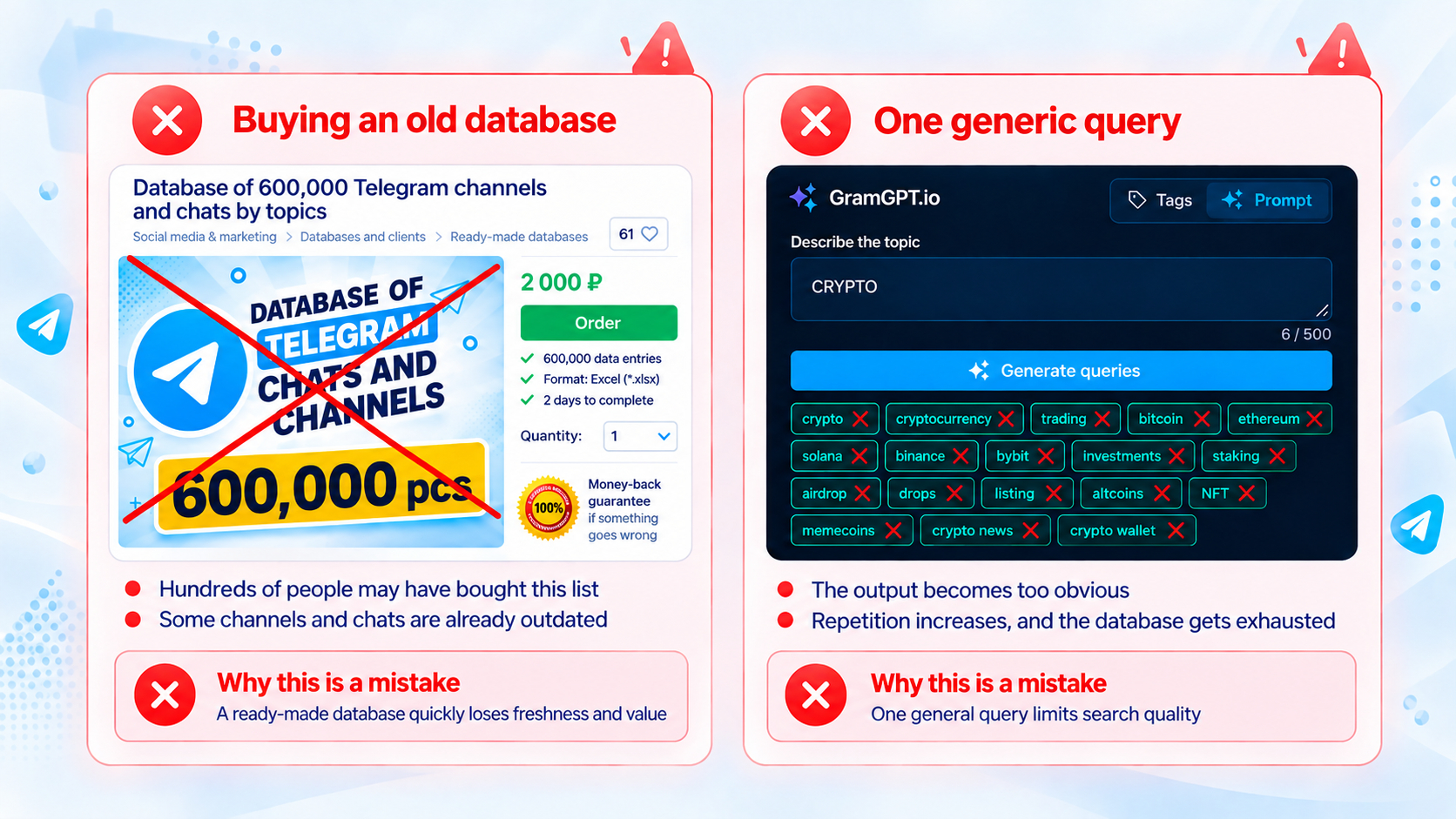
Third-party sites sell them as one file with tens of thousands of links. Such a file has three problems:
- hundreds of buyers already used it, so the audience there is tired of offers;
- it was collected long ago, and some communities have closed or changed focus;
- it has none of the conditions you need, so you throw away 80% of the links by hand.
On top of that, outdated archives often hide scam communities and bot farms. Writing there is risky: your accounts may get restricted after the first few messages. Consequently, a cheap file can end up costing you profiles, not just money.
Besides, these files almost never split the two types, so you sort them manually. That is why what matters is not the size of the list but a fresh sample for a specific task. We covered other options and their drawbacks in the article on where to get a ready list.
What You Get When You Buy a Telegram Database in GramGPT
At its core lies the verified GramGPT.io base of 2M+ channels and chats. Links are checked regularly, and every source has a topic, language, type, subscriber count and data on comment access.
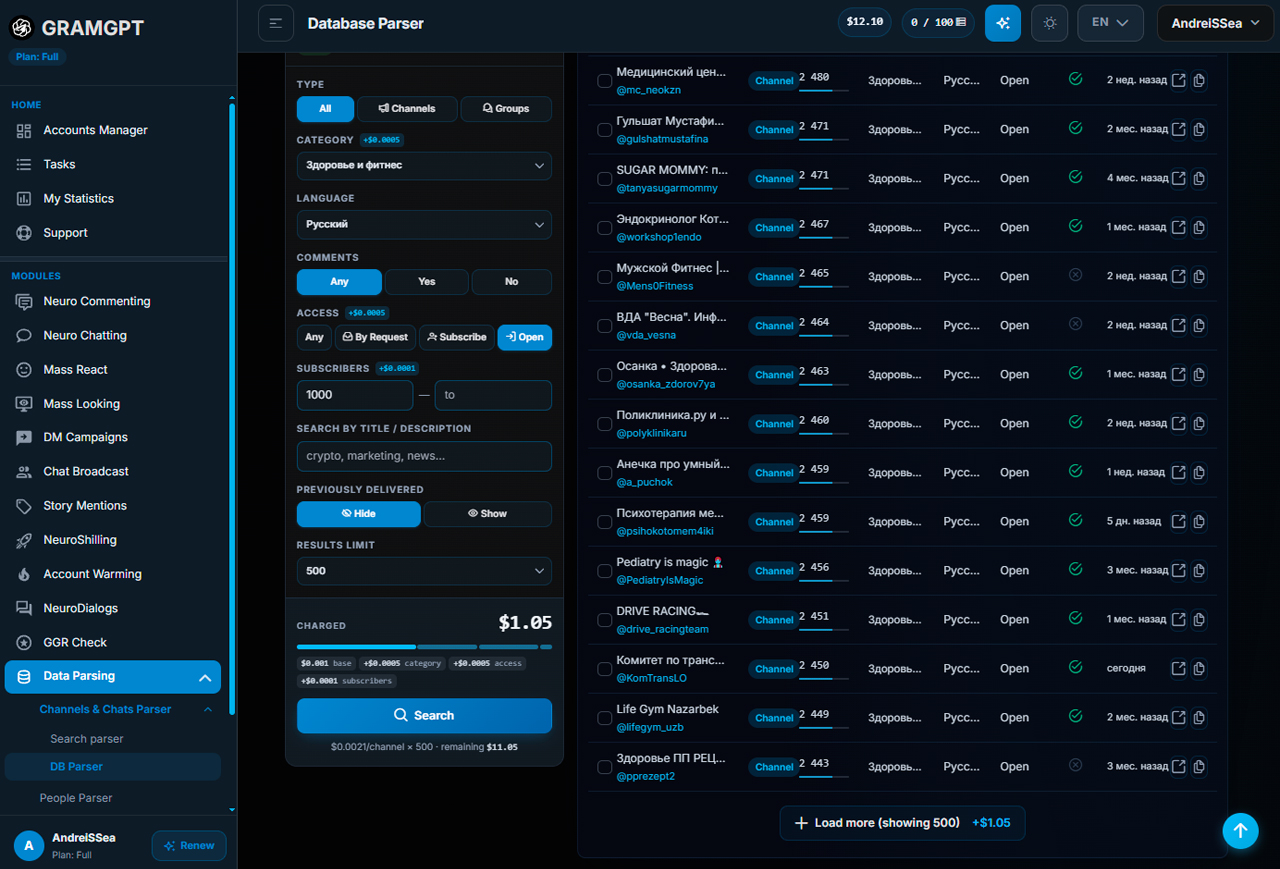
In other words, you buy not a file but a selection you build yourself in the Database Parser module:
- the two types are selected separately, depending on the task;
- conditions are set in advance, so the file has nothing extra;
- past exports can be excluded, so the new one has no repeats;
- everything arrives in seconds, not after days of manual collection.
Which Topics the Telegram Database Covers
The base covers the main niches people work with. For example, it holds thousands of groups in every large niche:
| Topic | Chats in the base |
|---|---|
| Making money online | 15,684 |
| Traffic arbitrage | 12,037 |
| Humor / memes | 11,902 |
| Crypto / trading | 8,421 |
| IT / development | 7,634 |
| Education / courses | 6,995 |
| Marketing / SMM | 6,281 |
| AI / neural networks | 4,876 |
| News | 4,307 |
| Psychology | 3,166 |
| Travel | 2,641 |
| Fitness / healthy living | 1,984 |
In total, the Telegram database holds over 2M entries. The numbers keep changing: new communities are added, and dead ones are removed during checks. So before paying, set your conditions and see how many matches are available.
How to Set Filters Before Paying
Say we need English-language health and fitness sources with an open discussion and at least 1,000 subscribers. The setup goes in order:
- pick the topic, for example "health and fitness";
- choose English, for instance;
- select the type: channels or chats;
- require an open discussion if the list is for commenting;
- set a minimum subscriber count, for example 1,000;
- if needed, add a word that must appear in the name or description;
- exclude previous collections;
- enter the amount you need and start the search.
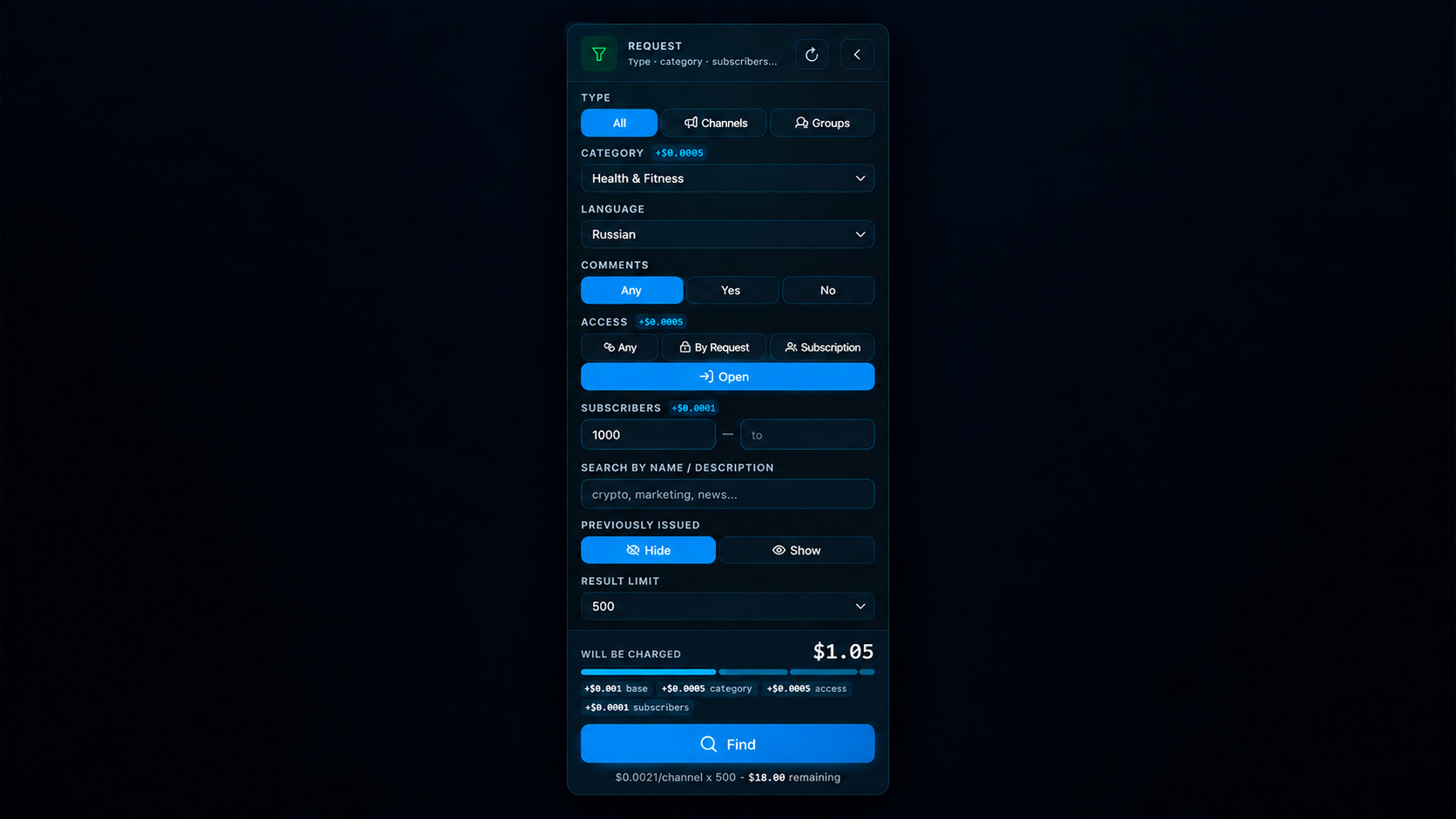
The same flow works for, say, crypto. Keep in mind that the language of a source does not always match the audience's country: an English source may be read far beyond the US. Therefore, for geo tasks it is better to add a niche and words in the name.
Example: a Sample for Crypto Commenting
Task: find English crypto sources for neurocommenting. Settings: topic "crypto and trading", language English, type "channels", open comments, from 1,000 subscribers, exclude past exports, amount 300.
Next, the parser returns the output, and you open 5–10 of them to check post dates and replies. If they fit, everything goes to neurocommenting. If not, add "news" or "signals" to the name filter and load the next batch.
How Much a Telegram Database Costs
You pay for the sources actually found, not for a "package". If 500 entries match your conditions, you get all 500. If fewer are found, you get and cover only what is available.
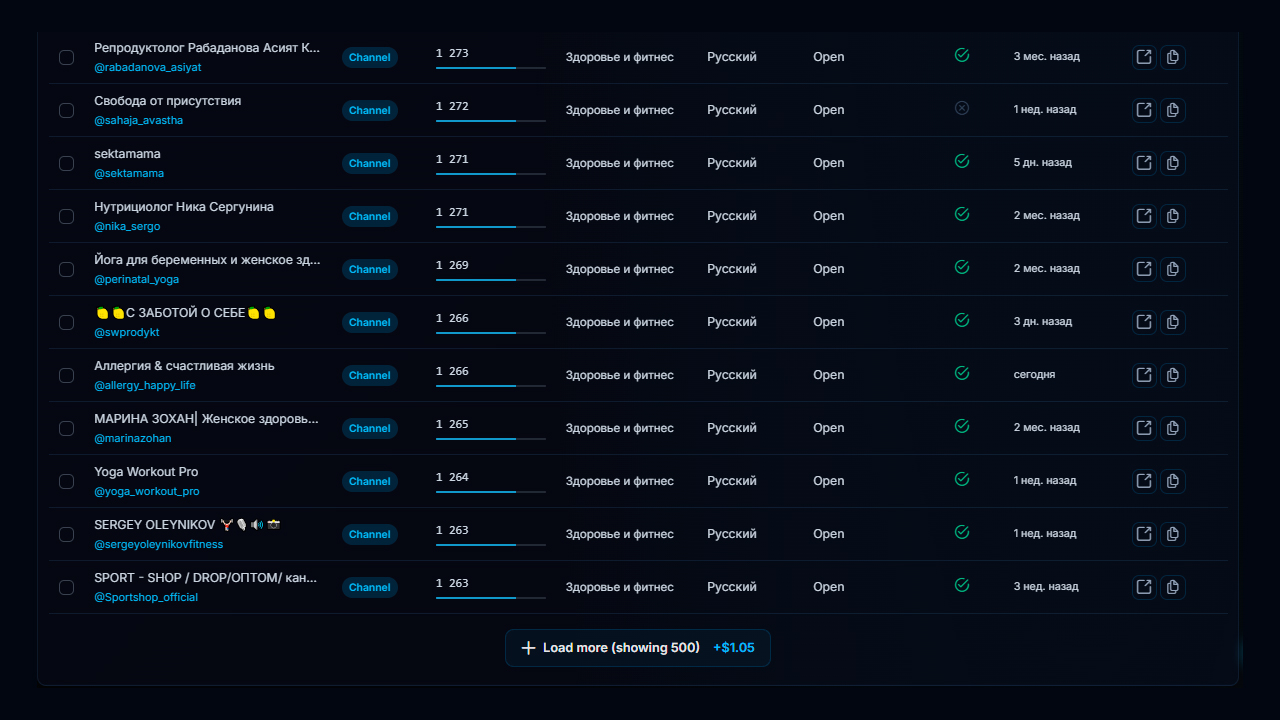
For example, in our test 500 fitness entries cost $1. When matches run out, click "Load more", and the service returns the next batch with the same conditions. In this way, your budget grows with the volume, and dead or irrelevant links cost nothing.
| Option | What you get | Drawbacks |
|---|---|---|
| Archive from another site | Tens of thousands of links in one file | Old links, overheated audience, no filters |
| GramGPT.io base | A fresh sample by your filters in seconds | You pay for each source found |
| Your own collection with the parser | No fee per link, subscription only | Needs accounts and more time |
A Telegram Database for Commenting and Ads
Such a selection serves two main tasks. The first is neurocommenting: accounts leave comments under posts, and some readers visit the profile. The second is finding placements for ads and cross-promotion, where audience size and activity matter.
For commenting, the key condition is an open discussion. So turn it on in advance, otherwise part of it will be useless. Also set a threshold of 1,000 subscribers: in tiny communities almost nobody sees a reply.
For ads, on the contrary, subject and locale matter more, while discussion settings are secondary. In that case, set a narrow topic and a word in the name, such as "news" or "review", to get one format. Then sort the file by subscribers and start talks with the best fits.
In both cases, exclude past exports. This way, every new purchase adds only fresh entries, and the budget does not go to old ones.
Buying Group Chats for Outreach
People most often look for chats: anyone can write there, so they are used for outreach, neurochatting and collecting members. In the parser module, choose the "chats" type and set the same conditions: topic, locale, member count and activity.
At the same time, two conditions matter for chats. First, any member must be allowed to write, otherwise it is useless for outreach. Second, the chat must have real conversation, not just ads. So afterwards, open a few of them and see whether people actually reply to each other.
Then they go to work: messages with your offer go out through the group mailing module, and user parsing collects active people from them.
How to Check a Purchased Sample in 5 Minutes
After you download the Telegram database, check 5–10 entries by hand. A couple of minutes show how precise your settings were. Look at five things:
- fresh messages are coming out;
- posts have views and reactions;
- the discussion is open, or anyone can write in the chat;
- its subject matches what you were looking for;
- the wording of posts matches the chosen locale.
Above all, look closely at the date of the last post. If a source has been silent for a month, nobody will read replies there, and ads will not pay off.
For example, if half of them do not fit, narrow the search: add a word to the name filter, raise the subscriber threshold or change the topic. As a result, the next batch will be more precise.
Mistakes That Make a Telegram Database More Expensive
Even with careful settings, you can still overpay. Here are the common reasons:
- A large volume right away. It is better to start with 100–200 entries, check them and only then load more.
- Too broad a niche. "Business" with no details gives a mixed bag, while "business" plus the word "marketplaces" in the name gives a precise one.
- Past exports are not excluded. In that case, entries already in your base get charged twice.
- No filter for the task. For instance, for commenting without an open discussion a third will be useless.
Where Your Telegram Database Is Stored
Moreover, every run is saved in the parsing history. You can return to it, view the output, copy everything or download a file. The latest run is shown separately, so it is easy to check it first.
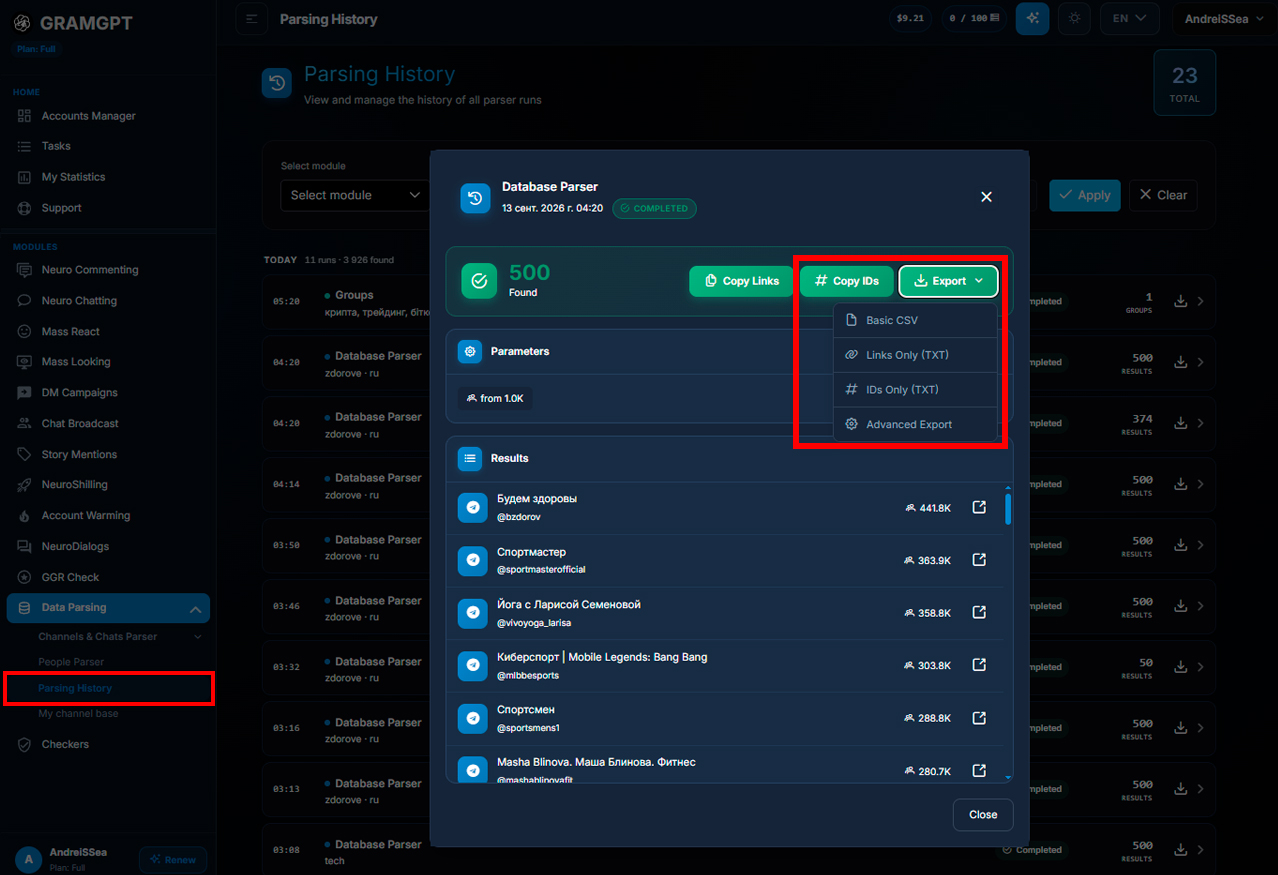
In addition, everything you find goes to My channel base and stays there with no time limit. There you can sort them into folders, filter by status and drop them into any module with the From base button. Saved exports also help avoid repeats: past purchases are excluded from each new one.
What to Do After the Purchase
However, the purchase is only the first step. Next, it is connected to GramGPT modules:
- neurocommenting: sources with an open discussion are loaded into neurocommenting, and accounts write AI comments under fresh posts;
- mass messaging: chats receive messages with your offer;
- audience collection: active users are pulled from these communities for direct messages;
- niche analysis: a spreadsheet shows the largest and liveliest players in a niche;
- inviting: people collected from chats are invited to your own community with the inviter.
Who Should Get a Telegram Database
A ready selection is most often bought by:
- affiliate marketers who need to test a new niche or geo quickly;
- publishers looking for ad and cross-promotion placements;
- neurocommenting teams who need sources with an open discussion;
- marketers and agencies who build lists for different clients.
If the task is regular and the volumes are large, it makes sense to combine purchases with your own collection. For example, take a starter sample for a couple of dollars and then expand it with the parser without paying per link.
Do Not Want to Buy: How to Collect It Yourself
Without a budget, however, everything is collected with your own accounts. For that, GramGPT has the search parser: it works on a $10 per month subscription, with no fee per item. You connect your accounts and run collections as often as you like. However, this takes time and connected accounts.
- channels are collected through search and recommendations: see the article on the channel parser;
- groups are found by keywords with suffixes: see the article on the group parser.
In practice, both approaches work well together. For example, start with a bought sample and then expand it through recommendations. In the end, your base does not depend on one source and stays relevant longer. And if you need it fast and precise, the easiest option is a Telegram database export in the Database Parser.