Skip to content
Automate
Traffic, funnels, bots
Start

How to Find Students for Tutoring or Teaching: 10 Ways That Work in 2026

How to Find Students for Tutoring or Teaching: 10 Ways That Work in 2026

September is over and your timetable shows three pupils instead of ten. Your profile on a lesson marketplace draws no responses, friends promised to "ask around," and moms in the class group recommend everyone except you. Figuring out how to find students for tutoring comes back every autumn, for beginners and veterans alike.

The issue is rarely your qualifications. But a parent usually picks whoever shows up at the right moment: the day a child brings home a bad grade, or six months before a big exam. If you are not on the platform, in the group or in their feed at that moment, the kid goes to someone else.

Below are 10 practical ways to get tutoring clients in 2026, from marketplaces and school communities to referrals, content and seasonal bootcamps. We also show how to catch "looking for a tutor" requests on Telegram without reading messages all day, and how to reach teens through stories.

Before You Find Students for Tutoring: Subject, Format and Season

Start by deciding exactly who you want to teach before you try to find students for tutoring. So "Math lessons" is too broad. "SAT math prep in 12 weeks, online, grades 10–11" instantly answers the family's real question: is this right for my kid? The sharper the offer, the easier it is to find students to tutor online and in person.

Demand also swings with the school year, so timing shapes how fast you find tutoring students. Also, in some months inquiries arrive by themselves, in others you have to go and earn them.

Period What happens What to do
August — September Peak demand, families choose for the year Refresh profiles, bump listings, message former pupils
October — November Early bad grades and mock tests Offer a no-cost assessment in local circles
January — March Exam prep turns urgent Exam bootcamps and mini-classes
April — May Last push before exams Short "8-week" courses
June — July Slow, but summer catch-up exists Help struggling kids, fill an autumn class

How to find students for tutoring: demand seasons and student sources

How to Find Students for Online Tutoring

Finding students to tutor online happens in three places today: request marketplaces, matching services and Telegram. Which one leads depends on your goal, since marketplaces bring early inquiries and group conversations bring urgent ones. Below we go through each and what it costs.

So platforms give you a fast start because the parent already arrived with a request. You only need to respond quickly and well. Still, that flow is paid for, through credits, promotion or a cut of every booking.

Request-Based Marketplaces

For example, on sites where families post a task and teachers send offers, the winner is rarely the cheapest one. Instead, it is the clearest: a short greeting, a plan for the opening sessions and a fixed price. Therefore, with zero reviews, take simpler requests at the start and ask for a review after three or four sessions.

Local service directories work the same way: families compare profiles, hourly rates and reviews.
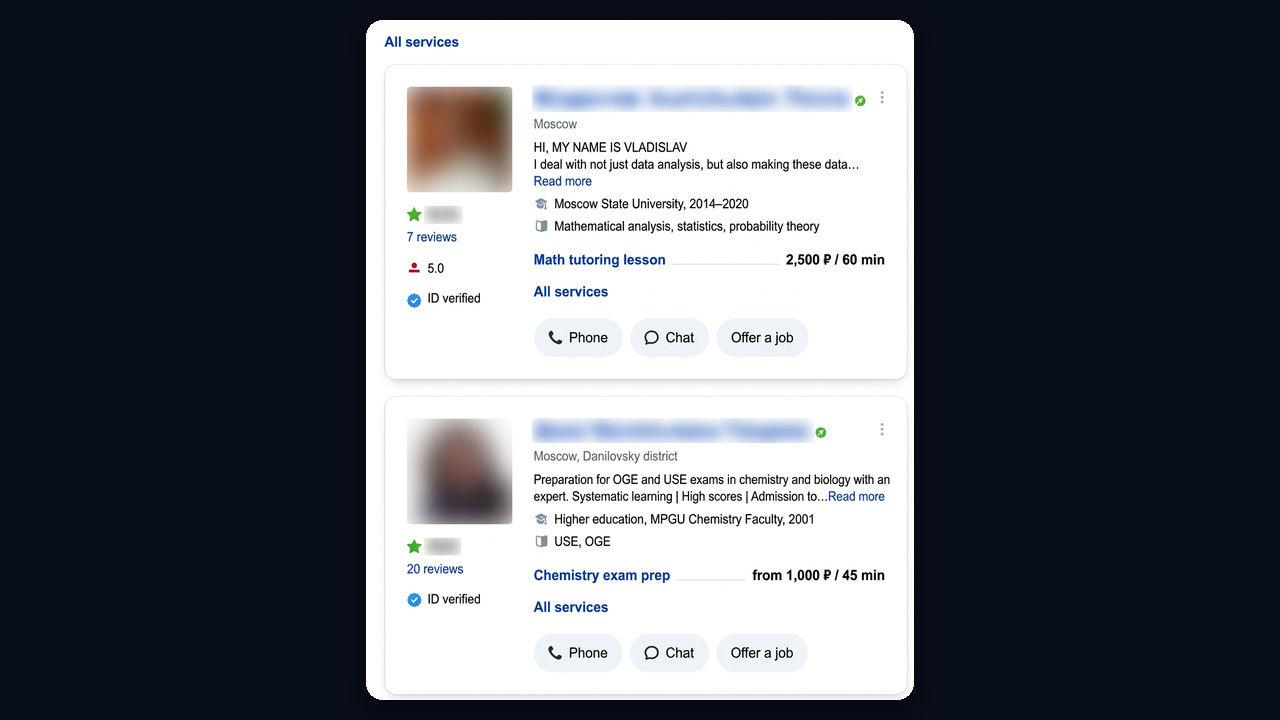
Tutoring marketplace with tutor profiles, prices and reviews

Classified Ads and Local Listings

Meanwhile, a free listing on local classifieds or a community board still works, especially for in-person lessons. So put the area and format in the title, for example "English lessons, online and near Central Park," add a photo from a real session and refresh the post regularly.

For example, a "math tutor" search in the Austin section of Craigslist shows dozens of posts. Notably, the same people repost every few days to stay on top.
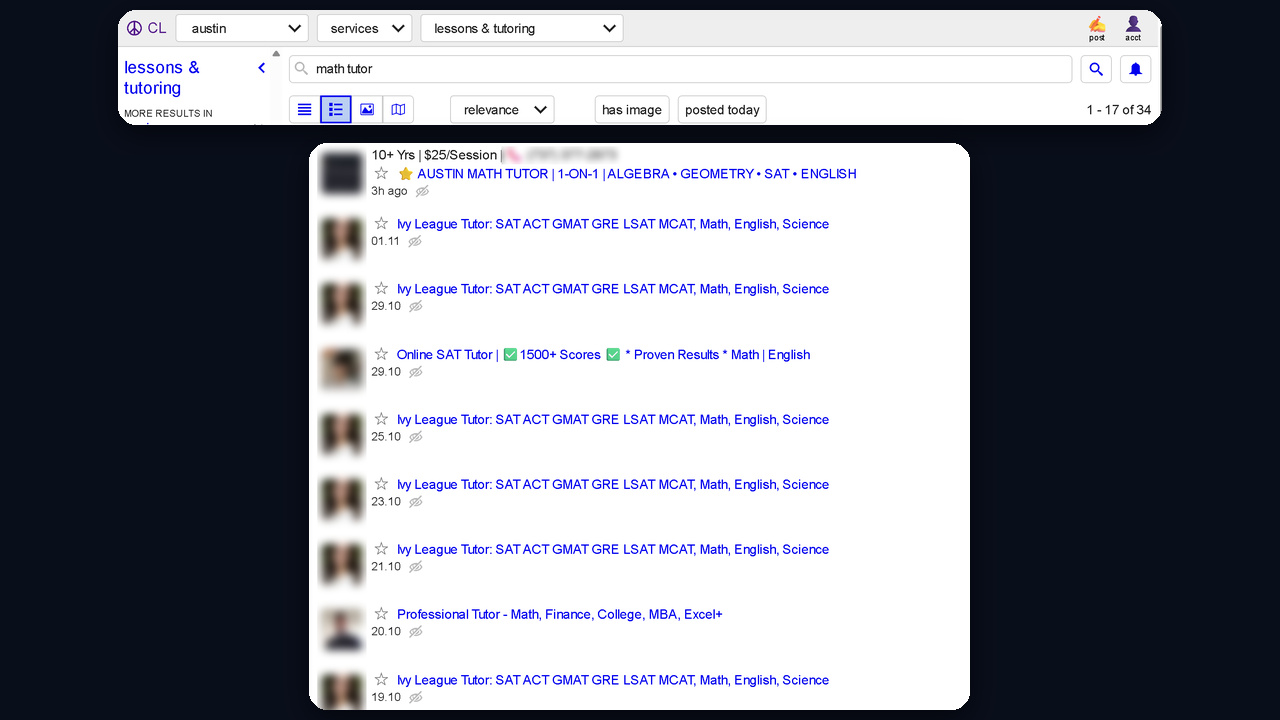
Math tutor ads on Craigslist: the same tutors repost to stay on top

Matching Services and Online Schools

Matching services such as Wyzant give you a free page and bring clients to you. However, they keep a share of what you earn. Besides, online schools suit teachers who value a full schedule over their own brand: the school brings the pupils, and you teach its program.
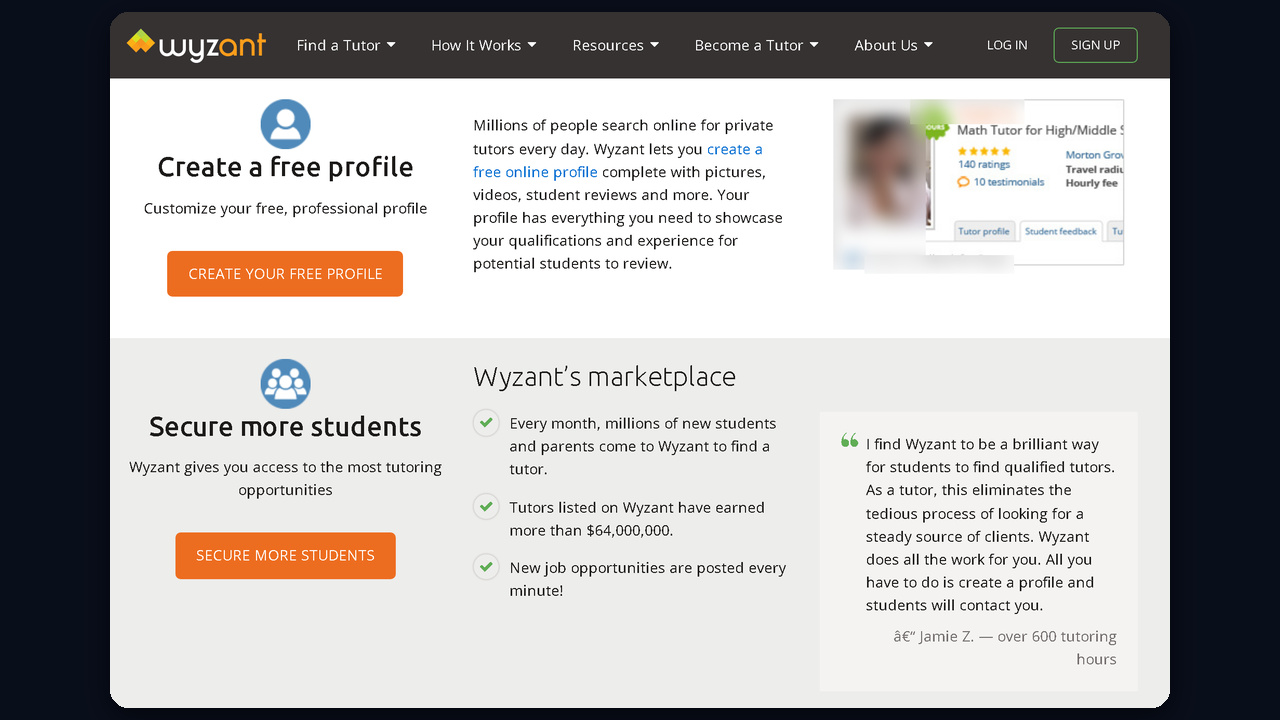
A tutor matching service: a free profile and a student marketplace

Parent Group Chats: Find Tutoring Students Fast

However, the hottest requests are not on platforms but in Telegram: class threads, neighborhood circles and exam-prep communities. "Can anyone recommend someone for chemistry?" or "Need help before finals, who teaches?" draws answers within minutes, and the job goes to whoever answered first with something useful.

In other words, this is the same hunt for tutoring clients as in any expert business: clients show up where questions get asked. We collected the general playbook in how to find clients on Telegram; below is what works for tutors in particular.

NeuroChatting: Replying to "Looking for a Tutor"

But nobody can read dozens of chats by hand, so in GramGPT.io this job goes to NeuroChatting: your account joins city conversations and talks there with AI. Triggers mode replies only to the phrases you choose. Interval mode, in contrast, keeps up a normal conversation with no triggers and answers questions about school and exams. We covered NeuroChatting setup in a separate review.

  1. Collect the places. Look for chats in the city where the student lives: neighborhoods, schools, exam prep. For remote teaching, hubs from other cities work too; we covered how to locate them in our guide to Telegram groups.
  2. Pick a mode. For Triggers, add phrases like "recommend a tutor," "doesn't get algebra" or "the SAT is coming." Interval mode needs no triggers.
  3. Write the prompt. You teach this subject, answer briefly and helpfully with no ads, and you suggest a trial in DMs.
  4. Polish the name and profile. The name works as an ad, since everyone who reads the reply sees the subject. Engaging name ideas: "Anna | Tutor | Math A+", "Anna | Tutor | SAT 1500+", "Anna | Math | Tutor". Feedback and schedule go in a pinned feed.
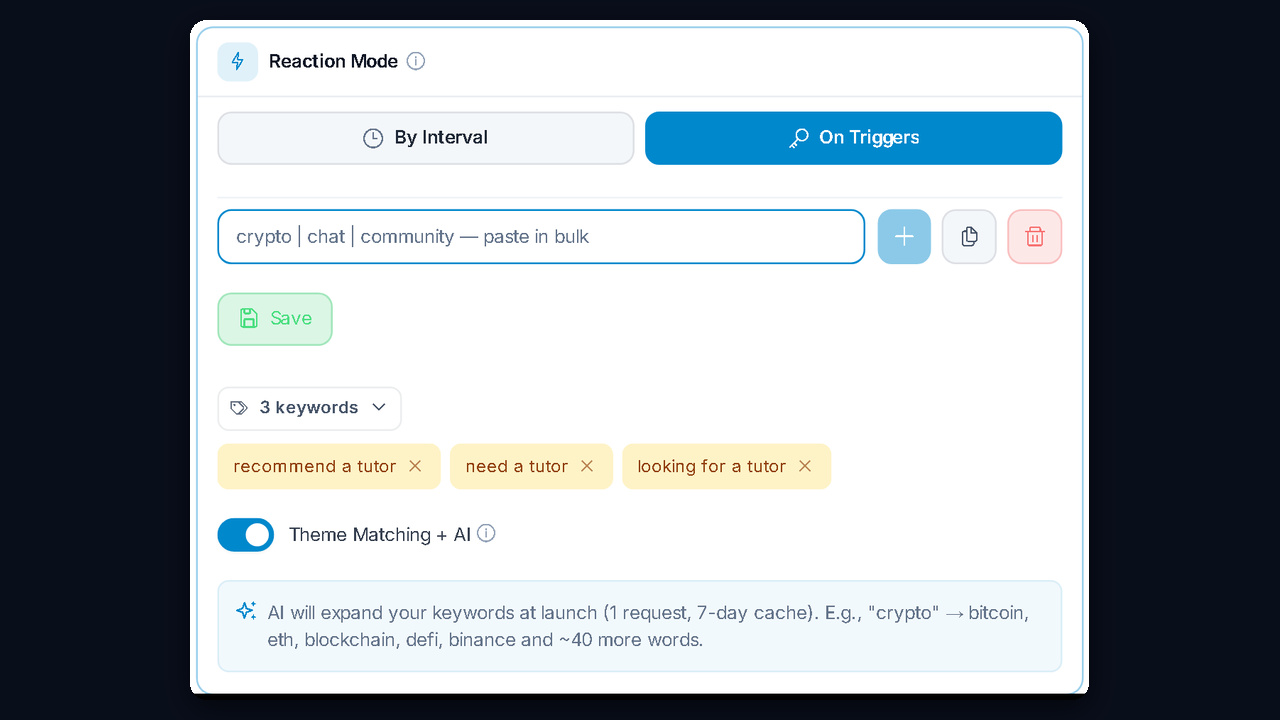
NeuroChatting triggers such as looking for a tutor in parent group chats

Example: An Austin City Chat Without Triggers

For example, in an Austin neighborhood thread a dad asks whether his son can move from 1210 to 1450 on the SAT by spring. There is no trigger phrase here, but in Interval mode the AI still answers as Anna:

"Realistic. Most points are lost on word problems and timing in Reading. Two sessions a week plus a full practice test every month usually add 150–250 points by spring."
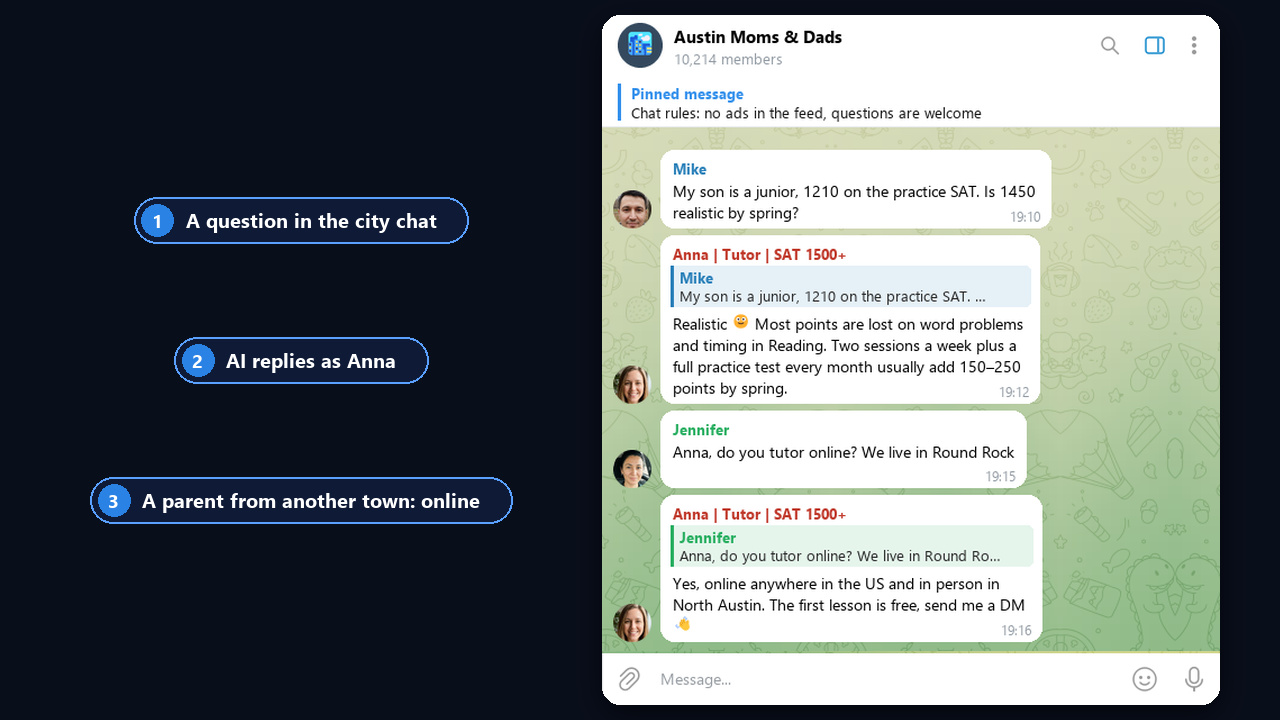
NeuroChatting for a tutor: AI replies to parents in a city chat

Then a mom from Round Rock asks about remote classes, and Anna invites her to a free first session. As a result, the parent sees useful advice, opens your profile and sees a pinned channel with reviews and prices. We showed how to set that up in a minute in our guide on adding a channel to your Telegram profile.
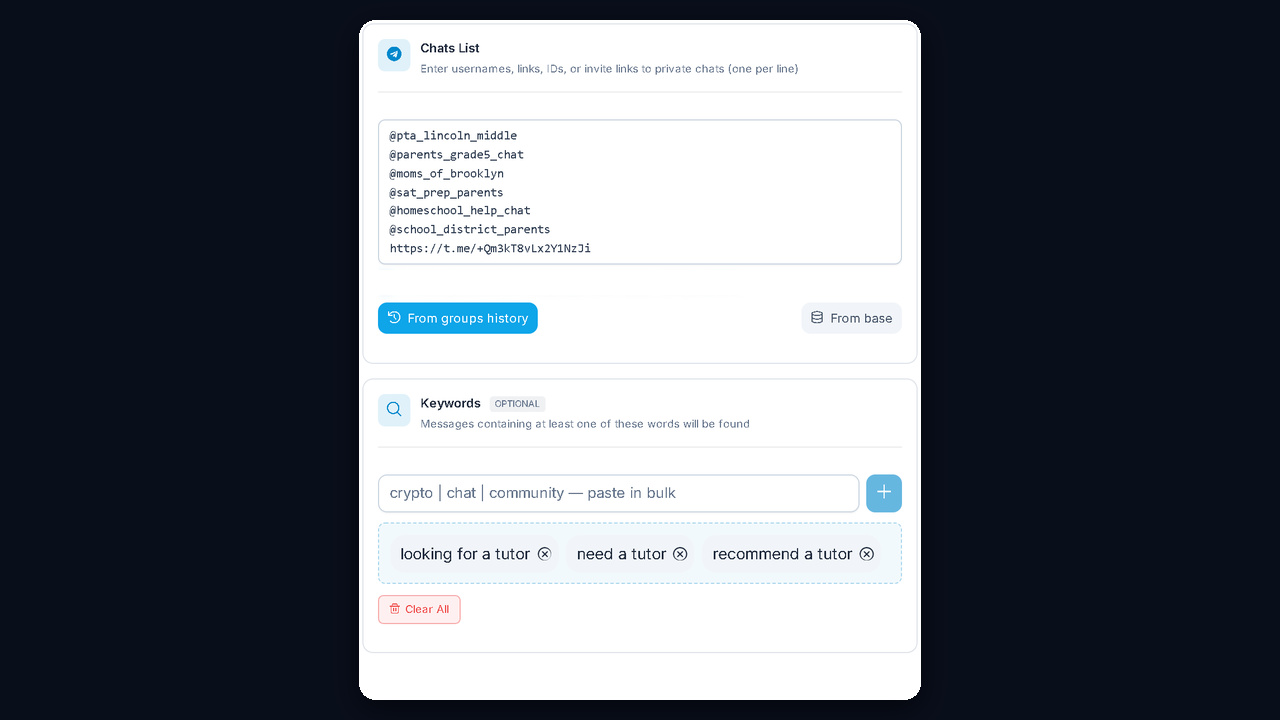
Message Parser: Who Asked for a Tutor This Month

However, some requests appeared days ago and never got a proper answer. That gives you another way to find students for tutoring. The parser's message mode surfaces those families, as our review of the hidden member parser by messages shows: list the groups, add keywords like "looking for a tutor" and pick a period, say 30 days. The output lists everyone who wrote such messages.

Finding students with the message parser and looking for a tutor keywords

Then reach out with substance, not an ad: "Saw your question in the 5B thread about algebra help. If it is still open, I can run a no-cost assessment." Note that the parser reads groups only, since in channels members are visible to admins alone.

Mass Tagging: Mentions in Stories

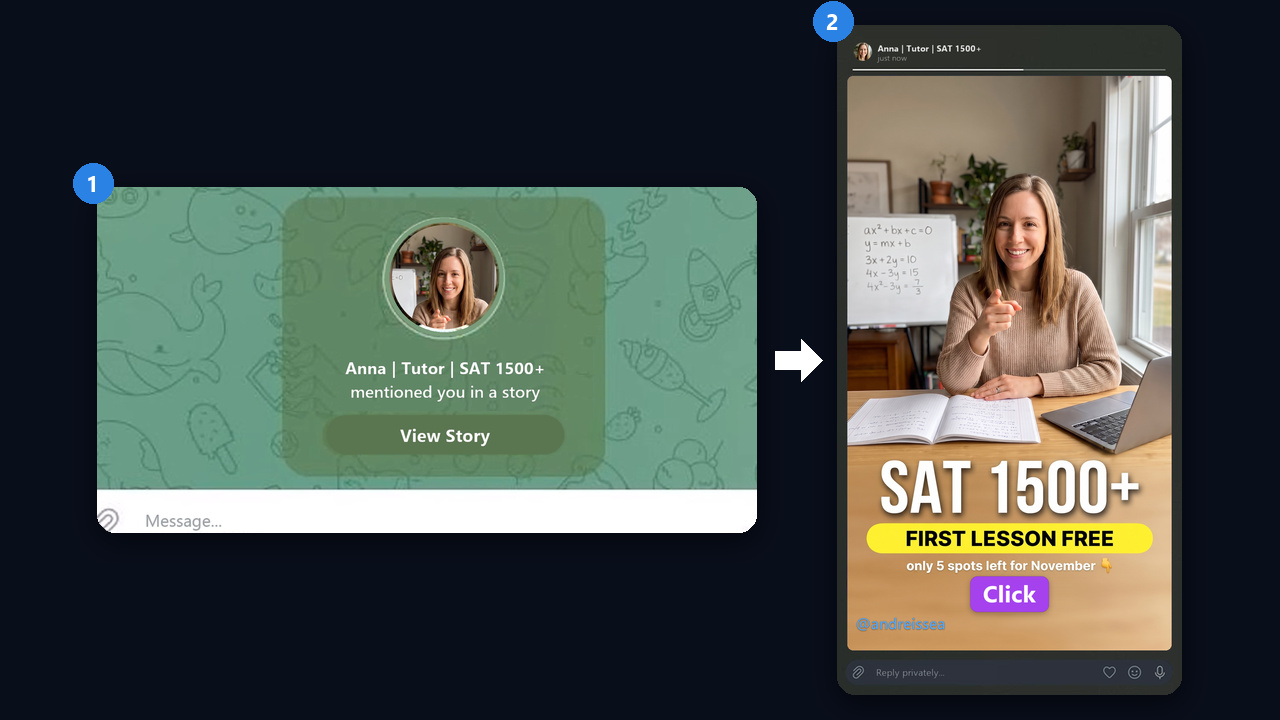
Mass tagging is one more way to find students for tutoring with no messages at all: the account posts a story and tags members of chosen groups in it. Each tagged user gets a "mentioned you in a story" notice and sees your name. SAT and ACT prep groups in your city fit best. For remote work, other cities fit too, since teens and their parents sit there.

Mass tagging for a tutor: a student tagged in an SAT 1500+ story

Give the story a hook: "SAT 1500+," "first lesson free," "only 5 spots left for November." Write the name the same way as for NeuroChatting. We explained the idea and mass tagging setup in a review. Besides, replies to those who write after the story can go to NeuroDialogs.

Referrals: Find Students for Tutoring Without Ads

Platforms and chats start the flow, yet a stable schedule rests on word of mouth. Besides, a happy mom brings one more child, but only if you ask.

Referral Offers and Reviews

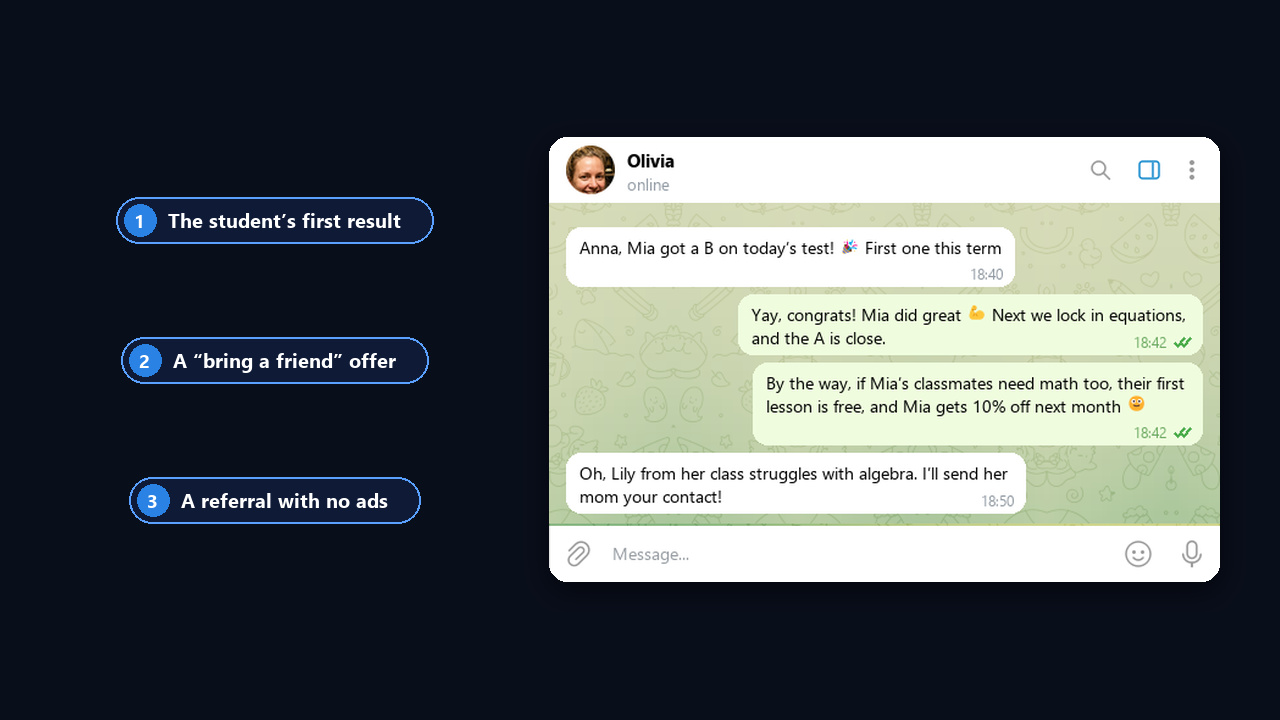
Then ask after the earliest visible win, like a B on a test or a passed mock exam. For example: "If any of Emma's classmates need help too, their first session is free and Emma saves 10% this month." Also, collect feedback right away and post them in your channel and on platforms. We described similar mechanics in our article on getting personal trainer clients.

A tutor referral offer to a parent after the first good grade

A Free Trial Lesson as the Door

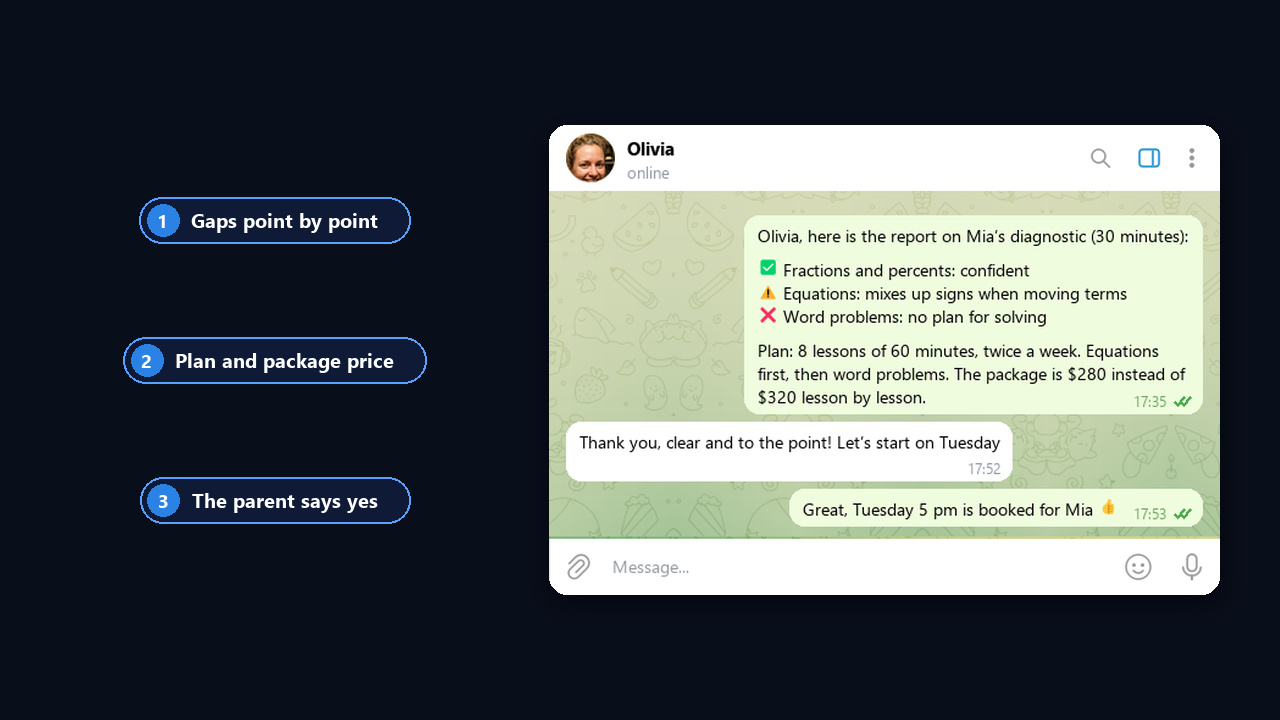
Besides, a trial removes the biggest fear at home: what if it does not click. Run it as an assessment rather than a regular lesson: 30 minutes, three tasks at different levels and a short report with a plan. In the end, that report is what turns a trial into a paid package.

A trial lesson report to a parent: gaps, plan and package price

Content That Finds Tutoring Students for Months

So families choose someone they trust, which is why useful content beats plain ads for a teacher. One clear walkthrough of a tricky problem sells your teaching longer than any listing.

A Telegram Channel and Short Videos

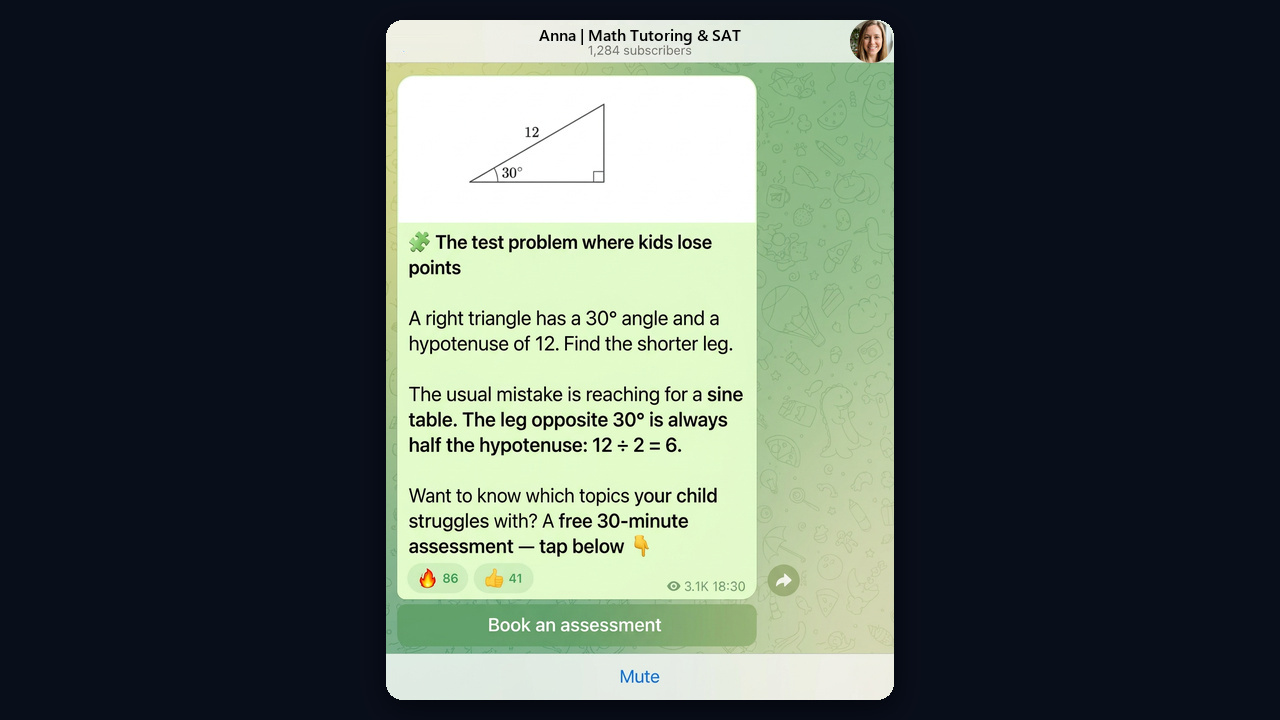
For instance, run your channel like a teacher's notebook: an exam problem breakdown, the mistake of the week, a pupil's result shared with the parents' consent. In addition, short explainer videos on YouTube Shorts or TikTok bring viewers from search, while your feed keeps those who are still deciding. Our guide on growing a Telegram channel covers the first readers.

A tutor Telegram channel with an exam problem breakdown and booking

To put your feed in front of families from the same homeroom threads, switch on Mass Looking: the account views their stories, and some of them tap through to see who it is.

Seasonal Bootcamps and Small Groups

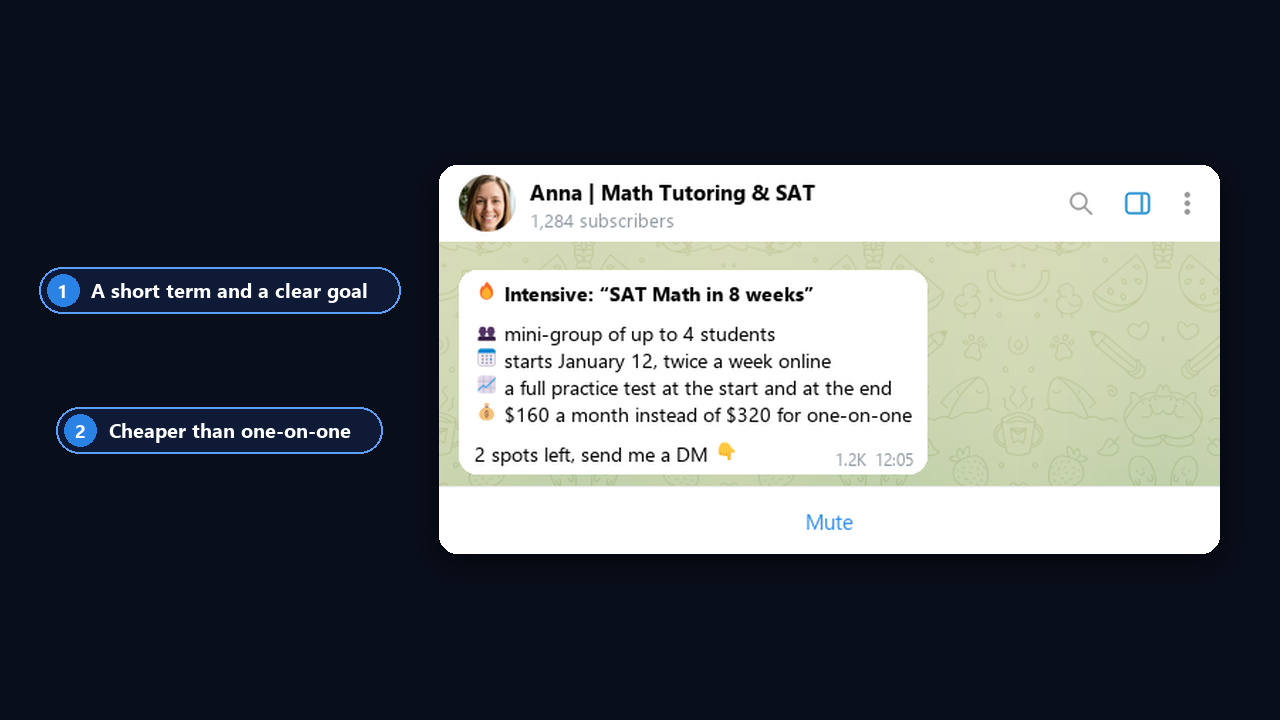
Also, in January and April, launch short bootcamps such as "Finals math in 8 weeks, four per class." Plus, a small class costs families less and pays you more per hour, and after the bootcamp some kids stay for one-to-one sessions.

An SAT math bootcamp for a small group: a tutor channel post

How to Find Students as a Teacher

A classroom teacher has an easier start than a newcomer: experience, credentials and colleagues are already there. Still, avoid taking paid pupils from your own class. It is a conflict of interest, and both parents and the administration tend to frown on it.

How to find students as a teacher: a teacher with a laptop and online learners

So where can a teacher land private learners outside their own school?

  • Colleagues from other schools. Swap pupils across the district: you take theirs, they take yours.
  • A profile built on experience. "Math teacher, 12 years in the classroom, exam marker" earns more trust than a plain "tutor".
  • Online academies. They value classroom experience, and the platform brings the kids.
  • Other schools' parents. Family threads in nearby districts, where nobody knows you as a homeroom teacher.

For example, an English teacher wins adult learners most easily: conversation clubs, professional circles and short phrase breakdowns bring them in without any marketplace.

Finding Your First Tutoring Students With No Reviews

Without testimonials, platforms convert poorly when you try to find students for tutoring. So start with your own circle and with neighborhood hubs. Speed matters here: your opening three to five families give you testimonials, and every step after that becomes easier.

  • Days 1–7. A marketplace profile, a local listing and a post for friends with a clear offer.
  • Days 8–14. Join 10–20 local school communities and answer subject questions.
  • Days 15–21. Run five trial assessments and send a report after each one.
  • Days 22–30. Ask for testimonials and launch your referral offer.

Finally, if you start in summer, focus on kids who are behind and on next year's seniors: by July families already plan for September.

Mistakes That Send Learners to Other Tutors

Mistake Better approach
"I teach every subject" One subject, grade and goal: "SAT math, grades 10–11"
Replying a day later Reply within an hour, even briefly
A trial with no takeaway Send a short report with gaps and a lesson plan
Ads in every chat Helpful public answers, offers only in DMs
Price "on request" Single and package prices right on your page

Conclusion: How to Find Students for Tutoring in 2026

Thus the fastest route combines platforms for early inquiries, school threads for urgent requests and referrals for a steady schedule. Content and seasonal bootcamps then add learners months ahead.

Monitoring conversations, answering parent requests, story tags and reaching households that already asked can be automated with NeuroChatting and other GramGPT.io modules, so the time you save goes into teaching.

FAQ

In family chats, through friends and former pupils, via free local listings and with story mentions through mass tagging.